
This entry is written by Truthful Loving Kindness (yes, that is my full legal name) for publishing at http://www.truthfulkindness.com, so PLEASE address any questions or comments to that website, regardless of which website shows these words.
In Greek, anhedonia literally translates to “without pleasure.”
It is a loss—or reduction—of the ability to feel pleasure.
Loss of pleasure is often assumed to be caused by depression.
But that is not necessarily the case.
Research shows that anhedonia, apathy, and depression are separate conditions, even though they can overlap. They involve different patterns within the brain, and the lived experience is not the same.
Personal Experience
Over the past several years, I have experienced a decrease in what I think of as the “feel-good” sensations.
At first, it was subtle—less intensity, less frequency.
More recently, it has become much more noticeable.
Experiences that once brought me great pleasure
now bring little to no direct pleasure at all.
And yet—this is important—something still remains.
I still experience comfort, purpose, and connection—but not the internal “reward signals” that used to come with them.
What I experience now is something I think of as “second-hand” or “logical” pleasure.
What “Second-Hand Pleasure” Feels Like
I can see my dog’s excitement when I play with him.
His wagging tail and enthusiasm show me that I matter to him.
That gives me something real.
When my husband smiles and opens his arms to hug me,
I feel something—not as a surge of pleasure, but as a clear knowing that I am important to him.
I still smile a lot.
Part of that is a conscious choice, and part of it is simply long habit.
The feeling is different—but the meaning is still there.
Pleasure vs. Comfort
There are also experiences that no longer bring pleasure, but still bring comfort.
For example, the wood fire in the living room.
I don’t get pleasure from it the way I once did.
But I do get comfort—from the warmth, the sound, and the lifelong association with “home.”
I continue to find comfort in expressing myself—especially through writing and art.
Not so much through spoken words, but through creating, and having those creations understood.
Helping others also brings comfort.
It aligns with my purpose of reflecting Truthful Loving Kindness.
Important Distinction
This is not the same as sadness.
This is not the same as depression.
This is a change in how the brain produces reward signals.
The input is still there:
- connection
- meaning
- purpose
But the internal signal that used to register as pleasure
is reduced or absent.
Dementia Types and Anhedonia
Different forms of dementia appear to relate to anhedonia in different ways:
- Fronto-Temporal Dementia (FTD):
Associated with changes in frontal and striatal brain regions. - Vascular Dementia / Post-Stroke:
Linked to specific brain lesion locations and stress-response system changes. - Lewy Body Dementia:
Involves depletion of neurotransmitters such as dopamine (reward and movement) and acetylcholine (thinking and memory). - Alzheimer’s Disease:
Studies suggest anhedonia—even without depression—may increase risk of progression from mild cognitive impairment.
What May Be Involved
Anhedonia appears to involve multiple brain regions, including:
- prefrontal cortex
- amygdala
- striatum
- insula
- basal ganglia
Several neurotransmitters are also involved:
- dopamine
- serotonin
- GABA
- glutamate
There are two commonly described forms:
- Social anhedonia (reduced pleasure in social interaction)
- Physical anhedonia (reduced pleasure in sensory experiences)
Closing
For me, anhedonia is not the absence of life.
It is the absence of a particular kind of internal signal.
The meaning is still there.
The relationships are still there.
The purpose is still there.
What has changed
is the way those things are felt.
*******

My Painting:
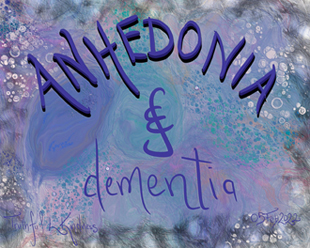
I created finished this painting 05Feb2022 as a way to express what anhedonia feels like from the inside.
It is not a lack of life or meaning.
It is more like the emotional “volume” has been turned down.
The colors remain.
The structure remains.
But the intensity of the internal response is reduced.
This matches my experience—where connection, purpose, and comfort are still present,
but the “feel-good” signals that used to accompany them are much quieter or absent.
Further Research & Links
For those who would like to explore this topic more deeply, here are some resources that may be helpful. As always, I encourage you to read with discernment and recognize that lived experience may not always match clinical description exactly.
Understanding Anhedonia in Neurodegenerative Conditions
- Anhedonia in Frontotemporal Dementia (2021 study summary)
https://neurosciencenews.com/anhedonia-ftd-18217/ - Post-Stroke Anhedonia (research article)
https://pubmed.ncbi.nlm.nih.gov/25678790/ - Anhedonia as a risk factor in Alzheimer’s Disease
https://www.mdpi.com/1660-4601/18/4/1370/htm
Neurotransmitters & Dementia (General Overview)
- Lewy Body Dementia — Johns Hopkins Medicine overview
https://www.hopkinsmedicine.org/health/conditions-and-diseases/dementia-with-lewy-bodies
Understanding Related Cognitive Conditions
- Understanding Anosognosia in Dementia
(lack of awareness of one’s own condition — often misunderstood as denial)
https://edenalt.org/understanding-anosognosia-in-dementia/
General Definition & Deeper Reading
- Anhedonia: A Comprehensive Handbook (Springer, 2014)
Discusses neurological basis of anhedonia within reward-processing systems. - Overview of Anhedonia Types (Social vs Physical)
https://thepsychologygroup.com/anhedonia/
Closing Note on Research
Anhedonia is currently understood as involving the brain’s reward-processing systems, particularly those connected to dopamine pathways.
However, research continues to evolve.
If you are supporting someone experiencing this, or experiencing it yourself, please remember:
Clinical descriptions can explain what may be happening
—but lived experience explains what it is actually like.
Both matter.

* Admin issues:
* Admin Notes — The subscription box is now located at the bottom of each blog entry. My full legal name is Truthful Loving Kindness. My current formal diagnosis remains at the stage of Mild Cognitive Impairment, although my Primary Care Physician and several other medical professionals consider it some form of dementia; my PCP records currently state “Dementia without behavioral disturbance, unspecified dementia type.” In recent years, my PCP, my husband/care-partner, and I have jointly decided to discontinue specialist consultations, as the distance and emotional strain of repeated evaluations are not worth the cost to my well-being. My symptoms most closely resemble Lewy Body and vascular dementia patterns; however, SPECT and PET imaging show the most significant brain changes in the temporal lobes, creating overlap with the logopenic variant of Primary Progressive Aphasia (PPA), a subtype within the frontotemporal dementia spectrum. Nothing in this blog is meant as medical, legal, or service dog advice; what I share here comes from lived experience—an attempt to design around decline and make daily life more workable—so please use your own judgment and consult professionals who understand your specific situation. Text Copyright © Truthful L. Kindness, 07Feb2022 . You can learn more about me under the “About Me” tab (note: that page is due for updating). Comments are welcome—please filter them through truthful loving kindness toward all concerned. As of 2026, I use ChatGPT as an editor, which improves readability and reduces the time I spend in the writing process. I do not mind re-posting of my work; however, if you do re-post, you must clearly indicate that the writing is not your own, prominently identify my authorship as Truthful Kindness, and include a clear link to my website so that questions and comments can be directed to me personally: at http://www.truthfulkindness.com.
Discover more from Truthful Loving Kindness
Subscribe to get the latest posts sent to your email.

I am still amazed by your ability to explain how you’re feeling.
When you teach us, you’re helping your brain.
It’s my feeling, your ambition (?) is amazing.
Thank you for continuing to educate us.
Get Outlook for Android
________________________________
LikeLiked by 2 people
There are some blessings to being born a person driven to analyze the goings-on within myself and my immediate environment.
Yes, i am discovering my driving motivation is strongly decreased … but it is still there. ((smile)).
Thank YOU for taking the time to read and comment, RuthAnn. ((hearts and hugs)).
Knowing that a topic that interested ME was received so well by YOU gives those “second-hand” blessings discussed above
THANK you so much !
— Tru
LikeLiked by 1 person
Pingback: February Pages | Truthful Loving Kindness