Lately i have been thinking about why paintings sometimes communicate things that words cannot.
Tru here.
Words usually happen one thing at a time.
One sentence. One direction. One thought following another.
But life is often not like that.
Especially with grief, dementia, trauma, chronic illness, caregiving, neurodivergence, or overwhelming emotion.
Sometimes many things are happening inside a person at once.
Fear. Love. Confusion. Recognition. Beauty. Exhaustion. Hope. Grief.
All at the same time.
.
A painting can hold that more easily than language can.
A painting can say: “I am struggling” and “I am still here” at the same time.
It can contain: fragmentation and connection, motion and stillness, confusion and recognition, fear and beauty.
Without forcing one to disappear.
.
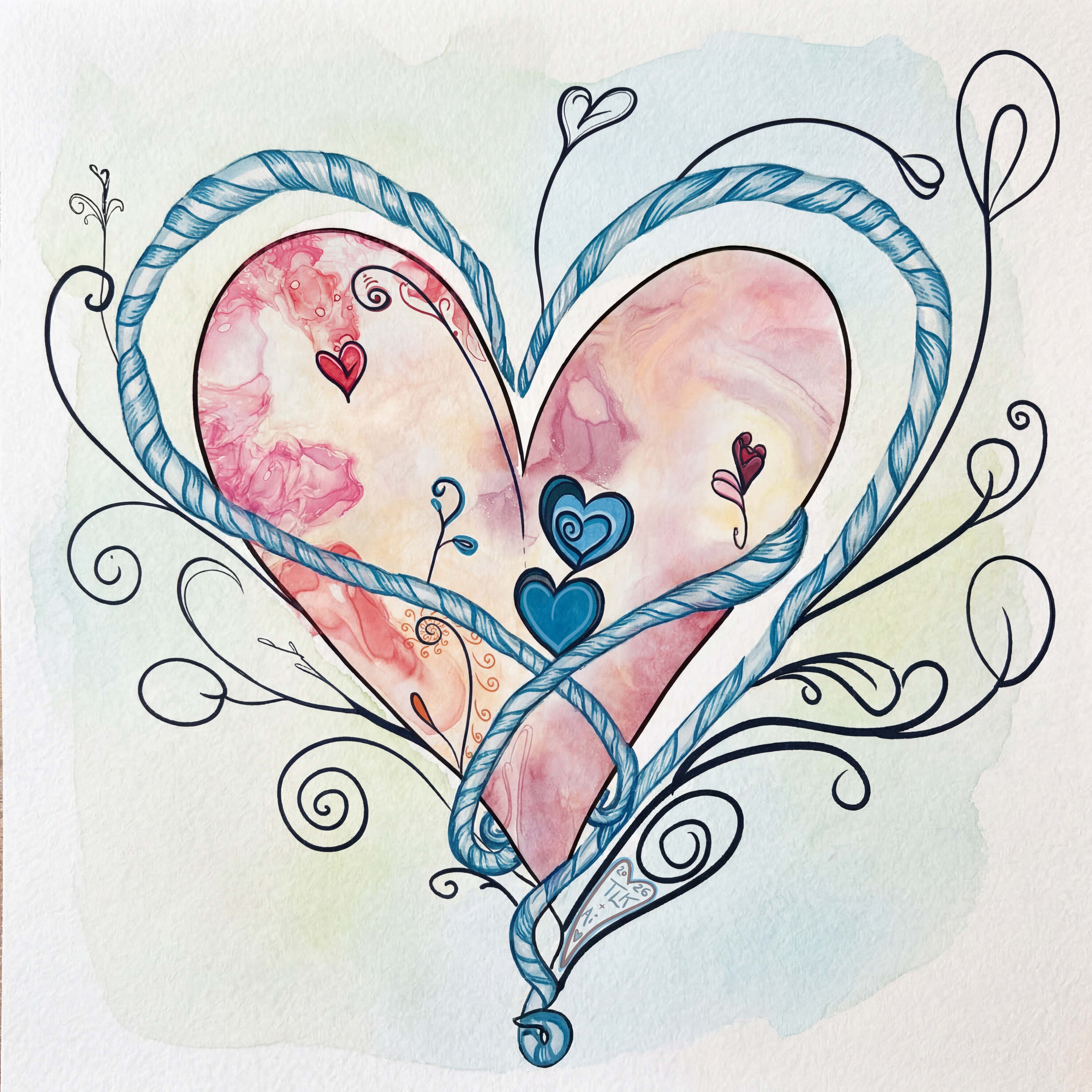
As my verbal comprehension has declined, i have depended more and more on visual communication. … a heart wrapped, some version of prayer hands, some version of grief expression, or thanksgiving.
At first i thought pictures were simply replacing words.
Now i am not so sure.
Maybe some experiences are simply too layered to fit neatly into language.
Words often require sequence.
But experience does not always arrive in sequence.
.
Sometimes confusion does not mean absence of thought.
Sometimes it means too much is happening at once.
Memory. Emotion. Noise. Recognition. Sensory overload. Physical discomfort. Relational tension. Fear of failure. Trying to keep up. Trying to appear normal.
All competing at the same time.
From outside, it may only look like confusion.
Inside, it can feel more like traffic.
.
That is part of why visual expression can feel safer.
Shapes, color, texture, and movement can communicate several things at once.
They do not always demand neat order.
.
Sometimes even diagnosis becomes hard to separate cleanly.
Many of us in neurological or chronic illness communities are not living with one isolated condition.
Where does Lyme disease end and dementia begin?
Where do autonomic symptoms separate from neurological symptoms?
Where does inflammation affect emotion? Where does exhaustion become cognitive overload? Where does grief affect memory?
Often nobody fully knows.
The body does not separate itself into tidy categories.
Everything influences everything else.
Neurological. Immune. Emotional. Sensory. Physical. Relational.
Sometimes several realities are happening together.
.
That uncertainty can be frightening.
But it can also teach humility.
Not everything separates cleanly.
Not every truth arrives one piece at a time.
.
That may be part of why abstraction has become increasingly important to me.
Abstract art does not always try to explain.
Sometimes it simply holds experience.
Not solved. Not corrected. Not fully organized.
Just honestly present.
.
Perhaps that is why so many people facing neurological illness, grief, trauma, or overwhelming emotion are drawn toward: music, painting, rhythm, texture, movement, or symbolic imagery.
Not because words are bad.
But because some human experiences are too alive, too layered, and too simultaneous to fit cleanly into sentences.
.
Sometimes more than one thing can be true at the same time.
And sometimes a painting can hold that truth more gently than words can.
*******
.
Associated LINKS on my own Blogsite:
My personal Facebook profile is under the name “Truthful Kindness,” and you can find more about me on this blog under the “About” tab (although that page was posted long ago and also needs updating). >> https://truthfulkindness.com/about/about-me/

Attached Picture:
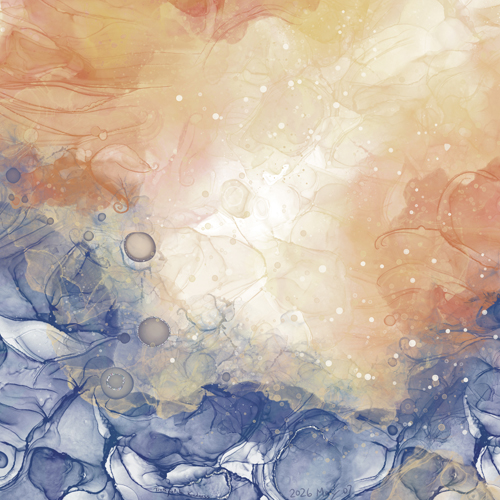
Yes; the cover photo is a digital painting of mine finished 2026May07. I mostly used AlainaJensen alcohol ink brushes , with Procreate tools on iPad that compensate for my tremors. The higher resolution picture shown above is available for free download from my Flickr acct at >> https://www.flickr.com/photos/194191353@N04/.
.Links used in this entry (in this case to avoid repetition, LOL)
Pictures as Words by Tru at >> https://truthfulkindness.com/2019/04/08/pictures-words/ <<
When Confusion Overwhelms Communication at >> https://truthfulkindness.com/2021/01/23/commun-4/ <<
Verbal Comprehension Strategies part 3 at >> https://truthfulkindness.com/2019/10/20/verbal-comprehension-strategies-3/ <<
Contact Options:
Other contact options are FaceBook and “X” (aka Twitter), both under “Truthful Kindness”. On Reddit, i am at “TruthfulKindness” in groups “r/dementia”, “r/lewybodydementia”, and “r/alzheimers”. i dropped my LinkedIn membership quite a few years ago. If requesting “friend” status for any form of Social media, please send a private message explaining that you are a reader of my blog. …

* Admin Notes — This entry is by Truthful Loving Kindness (my full legal name) for https://truthfulkindness.com/. For comments or questions, please use that website. The subscription box is now located at the bottom of each blog entry. My full legal name is Truthful Loving Kindness. My current formal diagnosis remains at the stage of Mild Cognitive Impairment, although my Primary Care Physician and several other medical professionals consider it some form of dementia; my PCP records currently state “Dementia without behavioral disturbance, unspecified dementia type.” In recent years, my PCP, my husband/care-partner, and I have jointly decided to discontinue specialist consultations, as the distance and emotional strain of repeated evaluations are not worth the cost to my well-being. My symptoms most closely resemble Lewy Body and vascular dementia patterns; however, SPECT and PET imaging show the most significant brain changes in the temporal lobes, creating overlap with the logopenic variant of Primary Progressive Aphasia (PPA), a subtype within the frontotemporal dementia spectrum. Nothing in this blog is meant as medical, legal, or service dog advice; what I share here comes from lived experience—an attempt to design around decline and make daily life more workable—so please use your own judgment and consult professionals who understand your specific situation. Text Copyright © Truthful L. Kindness, 2026May08. You can learn more about me under the “About Me” tab (note: that page is due for updating). Comments are welcome—please filter them through truthful loving kindness toward all concerned. As of 2026, I use ChatGPT as an editor, which improves readability and reduces the time I spend in the writing process. I do not mind re-posting of my work; however, if you do re-post, you must clearly indicate that the writing is not your own, prominently identify my authorship as Truthful Kindness, and include a clear link to my website so that questions and comments can be directed to me personally: at http://www.truthfulkindness.com.
*** categ: Arts&Crafts, Sx, Jrnl. <10 *** tags: abstract art, chronic illness, cognitive overload, communication, dementia, lewy body, neurodivergence, overlapping realities, person with dementia, PLwD, visual communication. *** S&S Categ: Non-Verbal communication, Confusion
Discover more from Truthful Loving Kindness
Subscribe to get the latest posts sent to your email.

Tru, thank you for this insight. Life and experience are not singular nor orderly. Words are limited in the apparent chaos. Art and music communicate without words and we each are free to take what we need at the moment. Their expressions are fluid and take on different meanings depending on each individual’s mindset at any given time. Thank you for your eloquent expressions in both art and word. Ellie
LikeLike
Ellie, thank you.
You expressed something important there; that art and music do not force a single meaning or emotional path. They leave room for the person entering them.
i think that freedom is part of why they can sometimes reach people more gently than explanation can.
Your phrase “depending on each individual’s mindset at any given time” especially resonates with me. The same painting can feel entirely different on different days, and perhaps that is because WE are different from moment to moment also.
Thank you for taking the time to reflect so thoughtfully on the entry and painting. ❤️
LikeLike