Favorite Films and WHY

Document your favorite movies and shows, but I think it VERY important to include why they are your favorites; what significance does this film have with your history and person ?
Document your favorite movies and shows, but I think it VERY important to include why they are your favorites; what significance does this film have with your history and person ?
Kate Swaffer comment got me thinking about quotes to live by, which motivated these thoughts about living in the moment.
These are things that were applicable for ME this year, so it is possible they might be helpful for someone else.)
One of our daughters regularly reminds us that it may be a slower process but it is almost always better to give alternatives, redirect, or to … turn the behavior upside-down and request the OPPOSITE behavior.

I still think term ‘sufferer’ gives teaching opportunity to say; “Did you realize this term has such a wide variety of usage meaning that it is currently polarizing the PWD and ‘care’ sector?”
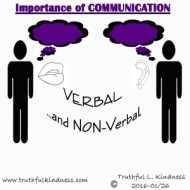
Be willing to invest NOW in learning communication skills for the later stages, so that you can more easily discern the language spoken in the “fading” communications of late-stage dementia … because relationships are what make life worth living.
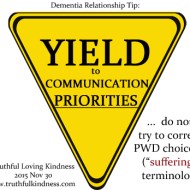
I have been admonished by more than one person; told that it is inappropriate for me to use the term “suffering” in connection with my dementia symptoms … but … Each of us SHOULD be allowed to describe our dementia symptom experiences, and describe them without fear of reprisal for the sake of political-correctness.

I was asked to think about what phrases and actions leave Persons With Dementia symptoms feeling left out. … Includes: Phrases that exaggerate my symptoms, Phrases that minimize (invalidate) my symptoms, Phrases that ignore my symptoms, Phrases that minimize (or ignore) my life-expectations, Actions that exaggerate my symptoms, Actions that ignore my symptoms, and Actions that exaggerate my “different-ness” or “alone-ness”.
All of these situations involve showing respect, embracing who the person is, and meeting them at their varied ability levels (because some aspects of abilities are still very high, and some quite low).

How many of our own children, grandchildren, or others watching us now, will be dealing with these same symptoms in future years?

Habit and schedule are important safety elements in dementia patient’s ability to complete activities of daily living. In unusual circumstances habit and schedule are interrupted. Food for thought in a true natural disaster.
