First DAA Conference in USA 2017

Tru here.

i have been VIRTUAL friends with many dementia folks for years.  After 2yrs, i met a few at the huge 2015 ADI Conference in Australia, so i realized that this time i needed to be better prepared for the tremendous excitement of actually meeting others in person.  i needed to prepare for adding the personal connection of touch to our friendship (and the cost of that excitement on my own energy reserves).  Because i am strong introvert, all these interactions are tremendously outrageously intense and important – but also each interaction COSTS me energy instead of giving me energy.

So this time i was ready for the personal friendship excitement.  I allowed plenty of personal introvert time before, during, and after the conference.  What totally overwhelmed me at the first Dementia Action Alliance conference in USA was the response from persons who were not themselves living with dementia symptoms.

In this first small conference i think we had 15 speakers with some type of dementia.  The opening and closing Plenary presentations were panels of persons with dementia.  Laurie Scherrer and i both spoke on use of Compensation Strategies  — another area where our lived experience gives us unique expertise.  The entire conference contained other experts, but highlighted expertise from various aspects of lived experience.  Just like each of us is still brilliant, but we are brilliant in alternate ways — the education we offered was not the standard fare usually offered by doctors, scientists and other professions.

i was gifted in several areas, and now most of those abilities are gone.  But i am still gifted, only in different ways.  Now i am gifted in devising Compensation Strategies and networking with persons with dementia then sharing those projects.  i think i was good at it before, but as my verbal abilities fail i suspect i am becoming even more gifted in communicating with facial and body language.  (Maybe that can compensate somewhat for the growing need to look at my notes more due to added memory problems every year, so having progressively less eye contact during public speech.)

We have alternative expertise from our lived experience.
By the closing Town Hall discussion, the people WITHOUT dementia were surprised at how helpful it was to hear directly from the experience of persons living with dementia. 

Suggestions were overflowing, from how to arrange help for presentation proposals, to methods for financing travel by Persons With Dementia for speaking opportunities.  Collectively, the response was tremendously exciting, and individually i was told how my words will have helped many many persons in large facilities in Georgia and nearby states, given suggestions for how facilities could maybe use the many data links i have been collecting from projects by other persons with dementia symptoms, and contacted about speaking in the future.  to the folks who contacted me individually for speaking, we (husband and i) suggested they contact DAA about forming a speakers group, and instead helping multiple persons speak.  It appears that is exactly what may happen with the possibility of a DAA Speaker’s Bureau.  Like some of my friends, i have been writing, and sharing material others have written for more than 4yrs.  But many times we feel like we must be mostly  “preaching to the choir” and achieving nothing but our own cognitive exercise.  Sometimes the purpose or mission seems futile, as far as having folks without dementia thirsty to hear and APPLY the expertise of lived dementia experience  — to their personal or professional interactions with persons with dementia, etc.

But by that closing Town Hall, i felt invigorated by how much we were able to help during this conference, and the future possibilities of others ready to invest in helping Persons With Dementia help others multiply this learning. 

Horay !  it is happening, so prepare for mobilization and dissemination; in other words, the scattering of seeds !!

* Admin issues: SHARE dementia awareness thru buttons below. Feel free to leave your thoughts in the form of comments, but please filter your comments with truthful loving kindness to all concerned. If interested in receiving notice of future blog postings, subscriptions are available through a “follow” button in the upper left corner (MS Explorer) or lower right (Safari, Mozilla Firefox and Chrome). If there is an advertisement below, I have no control over what is shown. My own full legal name is Truthful Loving Kindness. With the new terminology, my current diagnosis is still Mild Cognitive Impairment, but my neurologist said I am in a unique position for helping because I have “one foot in each door”. Text Copyright 2017-07/09. Tags are advocacy, alzheimers, conference, DAA, dementia, Dementia Action Alliance.

MyFreeCopyright.com Registered & Protected

Winner of “20-Best” Alz Blogs in 2015, 2016, and 2017

alzheimers best blogs badge
Healthline

Save

Save

Save

Save

Save

Save

Save

Save

Save

Save

Save

Save

Save

Hallucinations and Forgetting

Tru here.  For 50 years, my senses gave me accurate indications of my environment.  They were very helpful tools.

Then sound hallucinations began almost ten years ago.  Slowly smell and sight hallucinations were added as symptoms during next five or six years.  But until May 2017, i always remembered the possibility that what i was experiencing may possibly be hallucination — so not really as much cause for concern.

Newest development is that i forget hallucinations are a potential problem for me.  Therefore, whatever sensory experience i am having … is totally REAL.  Before, even knowing it was probably an hallucination did not change reality of event.  It is not like sitting in a movie theatre watching an experience.  It is the experience itself.  But this new change is huge.

Beginning last week, with sight hallucination of big bugs on floor, then this morning with 3 hours of smell hallucinations, i did not remember possibility that these experiences could be hallucinations.

…

Didn’t remember i had any cognitive problems at all.

Husband needed to remind me.  … After he checked the house, he suggested it might be an hallucination.

ugggh !!  Of course; how could i forget THAT ?

…

I am beginning to have times that i do not remember the need for cognitive strategies
— because 
i do not remember that i have any dementia symptoms. 

This is a huge change in perspective, and change in strategies that will be successful.
Also, if i don’t remember i have dementia symptoms.
then there is no need to share that lived experience for education of others.
Not tomorrow or next month, hopefully not even this year …

… but this marks the beginning of the end for my blog.

That window has begun to close.  So, continuing that thought, what can i do NOW to maximize usefulness of my own blog, and the blogs of my friends, for when i am no longer aware of the dementia issues?  When it is no longer my own responsibility ?  What can i put in place NOW, for continued public access after i am no longer able to advocate ?

any ideas ??

* Admin issues: SHARE dementia awareness thru buttons below. Feel free to leave your thoughts in the form of comments, but please filter your comments with truthful loving kindness to all concerned. If interested in receiving notice of future blog postings, subscriptions are available through a “follow” button in the upper left corner (MS Explorer) or lower right (Safari, Mozilla Firefox and Chrome). If there is an advertisement below, I have no control over what is shown. My own full legal name is Truthful Loving Kindness. With the new terminology, my current diagnosis is still Mild Cognitive Impairment, but my neurologist said I am in a unique position for helping because I have “one foot in each door”. Text Copyright 2017-06/01.  Tags are dementia, awareness, hallucinations, memory, advocacy.

MyFreeCopyright.com Registered & Protected

Winner of “20-Best” Alz Blogs in 2015, 2016, and 2017

alzheimers best blogs badge
Healthline

Save

Save

Save

Save

Save

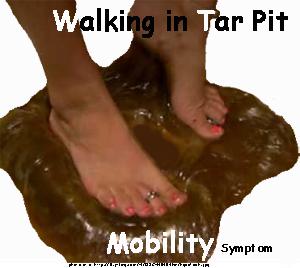
Walking in Tar Pit

Journal/Mobility Symptom:

Tru here.  Confusion and disorientation started out like heavy fog, making it difficult to see road signs.  That is about the time I lost my job (in 2000).  Then the cognitive fog got so dense that could not see road at all, in order to make sure driving on roadway.  Then about five years ago the mist became so thick that I needed to paddle in order to stay afloat.

Now instead of paddling in water, during the past few weeks it has felt more like a tar pit, constantly pulling my energy and making every movement extra difficult; not only mental but also physical movements.  Now needing assistance to move within the house, as well as walking outside of house.  Need service dog or walker to get to bathroom or my bed, or the desk.  Need nap every day now.  Fell badly.  Husband says it was about a week ago but i do not remember falling.

I remember my thumb was bright purple, but confused that still no sensations in the tip of it, and wrenched my knee.  With the extra time consumed from even MORE cognitive work-arounds that are needed lately, husband frustrated with so much of the only time i have left going to advocacy issues.

And unable to meet all my obligations lately, so gonna need to cut back further on what obligations i make.

Feel like i am letting everyone down, inside and out of the family.

Don’t feel like i am drowning yet  … just constant and unrelenting pull of mental and physical symptoms, dragging me down.  So gotta decrease expectations, increase strategies and put all aspects of life further into compound low gear.  ((I thought i was already in lowest gear, but maybe i can get some of my environment into lowest gear also, LOL)).


Thank you to those who have sent encouragement and positive wishes.  They are appreciated.  😀  — Tru


* Admin issues: SHARE dementia awareness thru buttons below. Feel free to leave your thoughts in the form of comments, but please filter your comments with truthful loving kindness to all concerned. If interested in receiving notice of future blog postings, subscriptions are available through a “follow” button in the upper left corner (MS Explorer) or lower right (Safari, Mozilla Firefox and Chrome). If there is an advertisement below, I have no control over what is shown. My own full legal name is Truthful Loving Kindness. With the new terminology, my current diagnosis is Mild Cognitive Impairment, but my neurologist said I am in a unique position for helping because I have “one foot in each door”. Text Copyright 2017-05/29.  Photo >>  http://i1.ytimg.com/vi/O3ZvHlNB4hw/hqdefault.jpg.  Tags are dementia, mobility, tar pit, relationships.

MyFreeCopyright.com Registered & Protected

Winner of “20-Best” Alz Blogs in 2015, 2016, and 2017

alzheimers best blogs badge
Healthline

Save

Save

Save

Save

Save

Save

Save

Save

Save

EMT 4PWD communication

“About us — without us” feels like manipulation.

Professionals (especially medical professionals) need E.M.T.
… for direct interaction with Persons With Dementia:

E= education/skills;

M= motivation/understanding;

T= time.

.

.

Tru here.  My first neurologist was splendid … but then retired.  The next year, the second neurologist gave me conclusions but not raw scores after i took their neuro-psych.  I suspect they thought withholding scores would force me to their office for all further visits, in order to provide comparison over time  — WRONG!  Never returned so went without comparison.  Took two years but found another neurologist.  Traveled 3.5hrs each way to get to him.  Quit my third neurology specialist on the second visit.  i gave him two visits because he would not slow down to talk WITH me on first visit.  But twice during second visit, i asked him to speak slower and pause between change of subject so that i could catch up with his thoughts.  Instead, he gave up on me, turned to my husband and spoke only with him for remainder of appointment.  So i fired his behind !  Took a year to find another specialist.  So far, he is a jewel; communicates directly and openly, showing me respect and treating me as a partner in my own care.  Dont know how it will develop with time, but starting out well at least.

Much of our interactions with doctors and professionals leave persons with dementia feeling left out from our own care team.  Without DIRECT communication, we are not allowed to be a partner, which does not build our cooperation in the process.
Many of my friends are no longer willing to see the doctor.  Why should we, if the doctor will not interact directly with the patient?

E.M.T.

E= Education for direct communication involves direct contact with Persons With Dementia during education process; with their first-person feelings and experiences …
in order to build communication skills that successfully work around cognitive and sensory dementia symptoms.  See links at bottom of page.

M= Motivation builds understanding for WHY professional should show respect for our humanity and make us a partner in our own care, by interacting directly with Person With Dementia.

T= Making TIME available for direct communication.  Professional might ask person to arrive early if they would like, and supply paper and pen to write down most pressing concerns they wish to share.  That gives extra time for person to find the words, because extra time is almost always required to work around dementia symptoms.  Another example might be to try using visuals when words don’t work.  My husband uses visuals for any numerical concept, geographical or distance concept, and descriptions.


There are wonderful exceptions.  My General Practitioner is a wonderful exception.  But searched for neurology specialist quite a while before i found someone willing to be completely open on subject, and speak directly with me.  This is too important of a specialty to settle for second-hand communication !

Reviewed lots of dementia research paperwork past few days for Dementia Action Alliance project on subject of “care”, and what hit me was that it felt like the research was entirely “about us — without us”, by medical professionals.  Felt like persons with dementia were merely THINGS; subjects of study; no longer considered valuable thinking feeling beings … but merely objects !  Researchers were the valuable stakeholders, but patient was not valued at all  — and not considered a stakeholder at all, so no “care” (or consideration) was shown to make them a partner in care.  Made me angry, and my primary response to anger or grief is writing.  So i wrote, and this is what came out.

Save

.

LINKS:

ECT Suggestions >> https://truthfulkindness.com/2014/12/12/suggestions-understand-audio-communication-dementia-symptoms/

Importance of >>  https://truthfulkindness.com/2016/01/26/import-communication-pwd/


Category: Important/Communication: https://truthfulkindness.com/category/important/communication-important/

.
* Admin issues: SHARE dementia awareness thru buttons below. Feel free to leave your thoughts in the form of comments, but please filter your comments with truthful loving kindness to all concerned. If interested in receiving notice of future blog postings, subscriptions are available through a “follow” button in the upper left corner (MS Explorer) or lower right (Safari, Mozilla Firefox and Chrome). If there is an advertisement below, I have no control over what is shown. My own full legal name is Truthful Loving Kindness. With the new terminology my current diagnosis is Mild Cognitive Impairment, but my neurologist said I am in a unique position for helping because I have “one foot in each door”. Copyright 2017-05/22. Tags are dementia, communication, professionals, research, and partnership.

MyFreeCopyright.com Registered & Protected

Winner of “20-Best” Alz Blogs in 2015, 2016, and 2017

alzheimers best blogs badge
Healthline

Save

Save

Save

Save

Save

Save

Save

Save

Save

Save

Save

Teaser from speech on Person-Centered Compensatory Strategies

Teaser excerpt from my planned “Person-Centered Compensatory Strategies” speech;

Tru here.  One method for predicting helpful strategies
is capitalizing on the thinking processes which work best
— and minimizing reliance on those that work least, so …

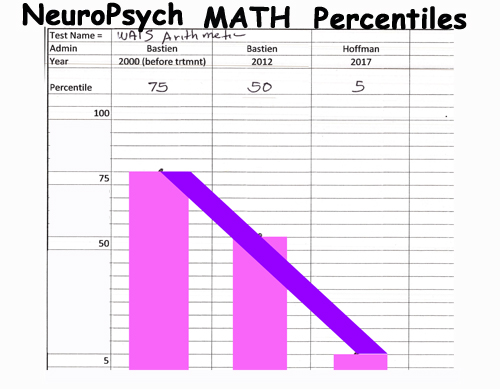
… for this slide we used just one category of my Neuro-Psych scores, compared over time — math.
I was in gifted math during grade school, Business Student of the Year in High School, and worked in Accounting.
So my math started out very high.

Even after i lost my job from what was probably my first small stroke, arithmetic was still at 75th percentile.
That means my math was still better than 75% of others with 2yrs college.
But as you can see it’s now dropped to 5th percentile.

Ugggh!!  Numbers, numbers, numbers!
I no longer understand numerical concepts over about ten.
Numbers 75 and 57 sound like the same amount to me,
and the numerals look like the same amount.

But remember my visual processing is still extremely high, and abstract thought is still high?
So the work-around is this;

Husband makes a pie chart, graph, or picture for the numerical concept.
Then we still have communication.


Example:
I was feeling neuro-psych testing was a waste.
So husband put together a graph for each score, with comparison thru time.

When i looked at all those graph pages with decreasing bars of color on them,
then i could see that neuro-psych testing was truly reflecting my cognitive loss
… so maybe it was not a waste of time.


You might consider how Neuro-Psych scores could help YOU tailor strategies
… at least until conditions change again.

George Huba is a person with Fronto-Temporal Dementia who has a PhD in Psychology.  His communication and scheduling ideas capitalize on visual processing.  Check out some of his blog entries at https://hubaisms.com/


You won’t want to miss this important dementia conference and interactive technology showcase for June in Atlanta!  Dementia Action Alliance conference info is at >> http://daanow.org/north-american-dementia-conference-technology-showcase/

.
* Admin issues: SHARE dementia awareness thru buttons below. Feel free to leave your thoughts in the form of comments, but please filter your comments with truthful loving kindness to all concerned. If interested in receiving notice of future blog postings, subscriptions are available through a “follow” button in the upper left corner (MS Explorer) or lower right (Safari, Mozilla Firefox and Chrome). If there is an advertisement below, I have no control over what is shown. My own full legal name is Truthful Loving Kindness. With the new terminology my current diagnosis is Mild Cognitive Impairment, but my neurologist said I am in a unique position for helping because I have “one foot in each door”. Copyright 2017-05/15.  Tags are dementia, strategy, Dementia Action Alliance, conference, numbers.

MyFreeCopyright.com Registered & Protected

Winner of “20-Best” Alz Blogs in 2015, 2016, and 2017

alzheimers best blogs badge
Healthline

Save

Top tip 4PWD: Grieve2Accept Dx n Find Purpose

Tru here.
G2AP: What do i consider the most crucial tip for Persons With Dementia?
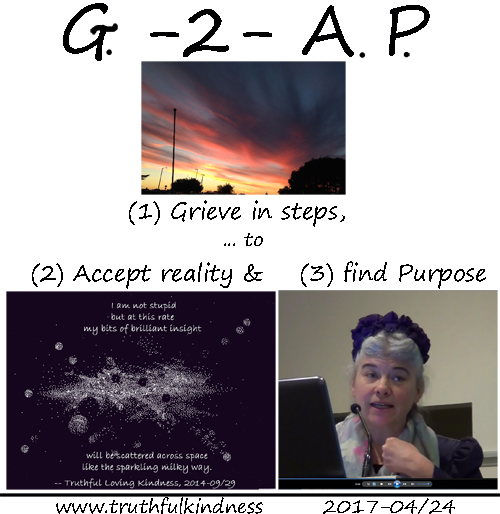
(1) Grieve in steps, … to (2) Accept reality, & (3) find Purpose.

“Must first
(1) GRIEVE incrementally, with each step in loss of abilities, behaviors, & expectations,
… in order to
(2) ACCEPT life as it IS and
(3) Find PURPOSE in current life.”
— Truthful L Kindness 2017-04/19


GRIEVE incrementally, with each step in loss of abilities, behaviors, and expectations,

“Saying goodbye to the things we once did, is so hard to do” — Harry Urban 2016-03/14

Sometimes we forget that (like most grief) living with dementia brings a type of grief that is a process; not an event.  As each new symptom appears or intensifies, we need to go thru the grief process again.

Usually the first time a symptom shows up is when i am sick or extra tired … and it is shocking.

The first time i did not recognize husband in public.
First time i did not recognize room of my house.
First time i did not recognize husband at home.
First hallucinations, etc.
But then it happens again
… and then the frequency increases until it becomes my “new normal”.

This is my new pattern of loss:   (a) Increasing frequency of loss.  (b) Increasing intensity of loss.  (c) Increasing experience of loss and grief, in order to bring … (d) Increasing appreciation for the blessings of life.  This grief must be recognized and dealt with in healthy ways in order to get past it and CHOOSE to focus on the blessings of life.

Sometimes the first stage of this grief feels like fear or anger.  It can trigger flight or fight adrenaline.  Before tremors were so bad, when this happened i could turn it into a productive act and cut kindling.  Now i can no longer handle spoon & fork well, let alone an axe or hatchet (LOL).  But if i am doing well enough and service dog trainee is not super-energetic that day, then he and i can take off walking down the gravel road to the harbor.  If pup is too full of energy and pulling me off my feet, then i will get on treadmill (which has extra-long support bars for balance).  Then … after i have worked the adrenaline off …  once in a while
…  I cry.

Sometimes i not only cry but i DESPERATELY cry, desperately pray, hug my fuzzy dog for long periods of time and go out with my pet chickens competing to sit on my lap … crochet with extra-soft cuddly yarn, or draw.  If these emotions hit late at night i will play my lap harp.  If while i am in the car then i grab my stuffed animal off the dash and stroke it while the tears fall.  It is okay to cry.  In larger perspective I consider it renewing because …Once i acknowledge and consciously experience the grief then, as they occur, i can use these repetitive symptom events as reminders to find compensatory tools and strategies for self and others to live as well as possible with the time we have available.  …  until the next round of grief comes due … then must experience it also, in order to get past it.

…  I choose to focus on life’s blessings (and the blessing in window of time for advocacy).
But in order to do that i must pass THRU and endure the grief.
Both are an important part of the complete process for keeping my life in a larger perspective.

When living with a dys-Ability
HOPE is crucially important for living each moment in a positive manner,
But … unless the person fully accepts a foundation of true REALITY
to build that hope upon,
their hope becomes a root for bitterness.

— Truthful Loving Kindness on  January 29, 2017

Harry Urban: “When you lose the things you taken for granted all your life, the reality of your disease takes hold.” — 2015-09/21  …
Gord Settle: “Sometimes you just have to let go”. — photo also by Gord Settle on 2016-Jan-03
Further detail at: https://truthfulkindness.com/2017/01/30/denial-one-sided-truth/  .
and examples at: https://truthfulkindness.com/2016/05/08/first-time-of-where-am-i/
& https://truthfulkindness.com/2014/11/10/melancholy-day/  .
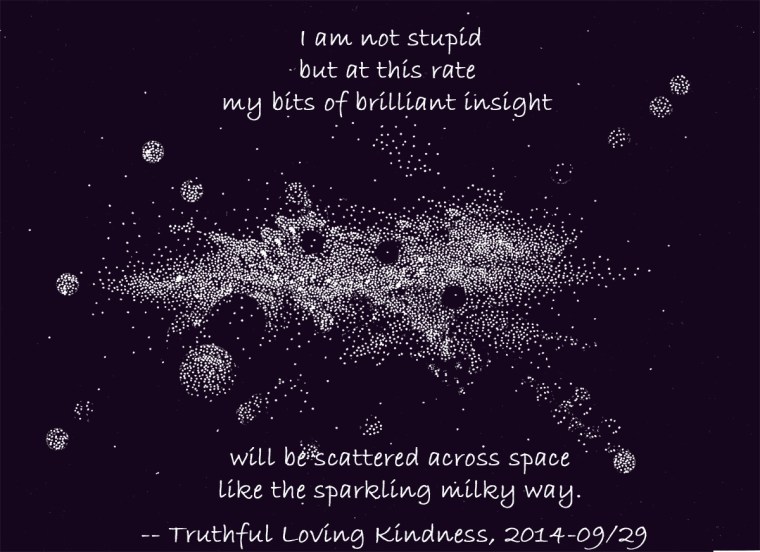


Fully ACCEPT reality

Must fully accept the negative aspects of the life we are now living before we will be able to accept and fully utilize the positive aspects of our current opportunities.  Both are part of the picture, and they come as a package.

“Without acknowledging the negative aspects of reality,
and allowing ourselves to go thru the process of grief
— repeatedly, at each step of our growing dys-Abilities from dementia symptoms,
we cannot ACCEPT those dys-Abilities,
own them as ours,
and find whatever work-arounds might be possible
to live the best moments of each day.
Otherwise, ‘Living Well with dementia’
is usually just denial and pretending.”
— Tru 2017-01/29

Robert Bowles has a new meaning for ASAP.  “A = Acceptance, S = Socialization, A = Attitude and P = Purpose.  I have found these four things to be the foundation of my living with Lewy Body Dementia (LBD) well.”  — Robert Bowles 2015-01/31

Harry Urban says:  “Like most people I went through the stages of denial, anger and over a period of time, I finally found acceptance with my diagnosis. It was not an easy journey finding ways to live beyond what I thought was a death sentence and found many of my friends and especially relatives have abandoned me and left me to fight my disease alone.”  — 2016-06/28.   “The first hurdle to cross is the acceptance of your diagnosis. This doesn’t mean you like it or you are giving up
but rather you are open to the options and changes you will be facing.”  — 2016-05/12.

“Only you can take that giant step toward acceptance of dementia, that is not saying you have to like it.
You have to believe that there is life beyond your diagnosis …
Don’t wait until it is to late to adapt to your new life.”  — Harry Urban 2015-04/05

Kelli McGowan: “I’m not escaping it
I’m embracing it” — 2016 Jan 28.

Robert’s ASAP blog entry is at >> http://lbdlivingbeyonddiagnosis.com/blog/asap  .


Find PURPOSE in current life

Your post-diagnosis purpose (or plural purposeS) may be continuation of pre-diagnosis purpose … or there may be brand-new purpose.

On learning he had terminal cancer, neurologist Oliver Sacks wrote, “I feel a sudden clear focus and perspective. There is no time for anything inessential. I must focus on myself, my work and my friends. … I shall no longer pay any attention to politics or arguments about global warming. This is not indifference but detachment — I still care deeply … but these are no longer my business; they belong to the future.”

After developing dementia symptoms over the previous 12 years, on learning my dementia was probably irreversible and progressive, I re-evaluated my priorities.  Like Oliver Sacks, I discovered a feeling of detachment for politics and other issues over which I had little control.  I mostly lost interest in anything that was not in my own sphere of influence.  Oliver Sacks put it well; it is no longer my responsibility.

Again we are back to “person-centered” because each person is so very different.  But when we receive a life-changing diagnosis it can trigger a re-evaluation that sometimes reveals obvious priorities that have been subordinated to “time-urgent” everyday trivialities.

At your own deepest levels, what drives YOU?  Historically, biologically, spiritually, socially, etc; what makes you more of YOU?  For me, I discovered that my identity was reflecting Truthful Loving Kindness.  To my surprise I can achieve that goal wonderfully as a Person With Dementia.  But also I requested that i have access to craft supplies and working space even if i am no longer able to use them in a fashion that OTHERS would expect.  Touching those materials brings an important part of what makes me feel alive.  Various types of dance have always been an important part of me being me, but with my balance issues in the past 10yrs, now looking into the option of wheelchair dance.  Spiritual contact time makes me feel alive.  Immersing my body in warm water makes me feel alive (whereas a shower feels like being attacked by water).  For me, short periods of time with meaningful intense communication is important.  For YOU, those priorities may be entirely different; you may crave adrenaline, travel, or being surrounded by large groups of family and friends.  That is okay because every person is different.  If those things have always been on your “bucket list” then maybe you should see which ones you can still deal with.

Chris Norris, in “Music Reawakening Report” ( http://www.arts4dementia.org.uk/music-reawakening-report ) says “I can still play the horn, and that is what drives me”.

Jeff Borghoff talks about Transcending and transforming IDENTITY in 5-min video at https://www.youtube.com/watch?v=RNx3yp-rIc8  .

Agnes Houston: “You can have a life after dementia, but it’s not handed to you on a platter. You’ve got to choose your path and it’s scary.” — 2016-01/07

Brian LeBlanc advocacy: “Thru my alzheimer’s journey, I have finally found what I was supposed to do, and it is the best job that I have ever had in my life … that I don’t get paid for” … ” get up & make a difference” — Brian LeBlanc 2015-09/17

Rick Phelps started Memory People Support group: “We Don’t have a cure, but we do have each other” — Rick Phelps 2015-10/04

Vicki Wells Bedard’s photo project: “I’m trying to string the good moments together, much like a rosary for my heart” — 2015-08/25

Harry Urban’s advocacy: “If I was magically cured … I no longer would have a purpose in life and I wonder if I would lose the gift to help others.” — 2015-10/02  …  “Being diagnosed with Alzheimer’s gave me a meaningful purpose in life and made me enjoy the things I am still able to do.” — 2015-09/07  …  “I no longer fear living with Alzheimer’s, my purpose in life is to help people find the answers to their questions and give them Hope living beyond their diagnosis. If I can do it, so can you.” — 2015-07/08

Terri Gadal: “Believe in yourself and all the possibilities within.  Allow the unfolding of a greater spirit to begin.  We already have all the elements we need as a gift from the divine.  We have the power and vision necessary to remove the obstacles and blocks in our lives. To create a new path in our destiny.  To follow the high road and to always be grateful for the blessings in our life.” — posted 2013-10/03

Further detail at  https://truthfulkindness.com/2015/09/11/my-philosophy-on-personhood-and-dementia-person-personality-perspective/ & https://truthfulkindness.com/about/  .
* Admin issues: SHARE dementia awareness thru buttons below. Feel free to leave your thoughts in the form of comments, but please filter your comments with truthful loving kindness to all concerned. If interested in receiving notice of future blog postings, subscriptions are available through a “follow” button in the upper left corner (MS Explorer) or lower right (Safari, Mozilla Firefox and Chrome). If there is an advertisement below, I have no control over what is shown. My own full legal name is Truthful Loving Kindness. With the new terminology my current diagnosis is Mild Cognitive Impairment, but my neurologist said I am in a unique position for helping because I have “one foot in each door”. Copyright 2017-04/21. Invested 14hrs during 3days. Tags are dementia, grief, acceptance purpose, strategy.

MyFreeCopyright.com Registered & Protected

20-Best Alz Blogs in 2015, 2016, and 2017

alzheimers best blogs badge
Healthline

Person-Centered Strategies

Tru here.
My most useful strategies are those that are very person-centered. Graphic below began with the person-centered graphic we used in Dementia Action Alliance’s white paper of “Living with Dementia: Changing the Status-Quo” found here >> http://daanow.org/wp-content/uploads/2016/04/Living_Fully_With_Dementia_White-Paper_040316.pdf
Really appreciate “Wings of Prayer” drawing by Sunny Chandra, of Singapore, and meditation drawing from McNair Scholar’s Rock.

General tool: Muscle-Memory.
Specific tool: computer graph paper.

Learned to type at ten years old, so muscle memory for that is very deeply embedded.  i was business student of the year during high school, and proficient on all business machines.  25 years ago i was my company’s expert in using computer spreadsheets (digital graph paper where you fill in rows and columns).  My brain needs only little effort on remembering how to use this software tool because muscle memory for those functions are still automatic.

So, for right now, my biggest complications are remembering what project i am working on, what step i am in the project, and WHERE i saved pertinent information.  With decline in use of Lotus software (spreadsheet program i knew best), transfer to Microsoft Excel program, and that software’s continual evolution, muscle memory does not help when software loses capacity to use Lotus functions.  But right NOW, a computer spreadsheet is still a useful tool … for this particular person, with this history, set of talents, and interests.  Most folks are surprised that written lists are becoming less and less helpful for me … but a computer spreadsheet is still helpful.  I think a lot of that is because it cannot be lost or left behind (along with ability to sort by different criteria).  Digital backup is always filed in computer according to dewey decimal system (which others can help me with if i forget).  My most crucial tools are also on cell phone.  One of the biggest problems is that many women’s clothes no longer have pockets large enough for a cell phone … especially if pocket already holds dog-training treats and handkerchief.  LOL !

I think compensation tools need to be extremely person-centered.

General tool: relationships.
Specific tool: spiritual life.

Theology has been a major interest since the summer before i turned six years old.  So my spiritual life is not only a strong sustaining factor for me, but actually part of my compensation TOOLS for dealing with discouragement and loss of activities/behaviors that i strongly associate with my personhood.  It surprises some folks, but while most aspects of my life are declining, my spiritual life is still continually growing.  See separate blog for my spiritual journey.  >> https://tlk4spiritual.wordpress.com/

Again; effective tools are extremely person-centered !

Collection of Links for other symptom tips:  https://truthfulkindness.com/category/symptoms/dementia-symptom-tips/

* Admin issues: SHARE dementia awareness thru buttons below. Feel free to leave your thoughts in the form of comments, but please filter your comments with truthful loving kindness to all concerned. If interested in receiving notice of future blog postings, subscriptions are available through a “follow” button in the upper left corner (MS Explorer) or lower right (Safari, Mozilla Firefox and Chrome). If there is an advertisement below, I have no control over what is shown. My own full legal name is Truthful Loving Kindness. With the new terminology my current diagnosis is Mild Cognitive Impairment, but my neurologist said I am in a unique position for helping because I have “one foot in each door”. Copyright 2017-04/13. Invested 3.5hrs in text & 3hrs in graphic.  Tags are dementia, person-centered, strategy, tools.

MyFreeCopyright.com Registered & Protected

20-Best Alz Blogs in 2015, 2016, and 2017

alzheimers best blogs badge
Healthline

Newest Writings

I have been very busy with my Service Dog trainee, Dementia Mentors, Dementia Action Alliance, and Dementia Chats.  But just because I have no recent blog entry postings does not mean there is nothing new to read from Truthful Loving Kindness.

NEWEST  PROJECT

SUFFERING and Pre-View of Book “Dancing With Elephants”

616-jarem-bk-dancingwelephants-3in100ppi

Have read early pre-view for first 3 chapters of Jarem’s thought-ful book “Dancing with Elephants:
Mindfulness Training For Those Living With Dementia, Chronic Illness or an Aging Brain”.

Tru here. I just pre-ordered book thru Amazon because Jarem has offered FANTASTIC bargain;
“Great Mindfulness Package to anyone who buys the book and emails him (great.mindfulness.dancing@gmail.com) a picture of their receipt before March 12, 2017!”

  • A More Healing Way – audio/video series – Jarem interviews other authors on facing death, disease and chronic illness ((Tru here: interests me personally because includes videos from both Patch Adams MD & Jon Kabat-Zinn, among others))
  • Access to a live, 60-minute webinar on “Mindfully Facing Life and Death” with Q&A with Jarem
  • Audiobook read by Jarem ((Tru here: very helpful for my own comprehension to have both visual reading and audio hearing of same words simultaneously))
  • All the digital editions of the book (kindle, nook, ipad, pdf) ((Tru here: personally much appreciate Kindle tools))
  • 30-day Dancing with Elephants Journal and Workbook

Preface is that my dementia symptoms make reading comprehension difficult, and was pleased to discover manuscript is separated into bite-sized pieces that do not appear to need a whole lot of memory retaining past paragraphs in order to process current paragraph.  I use the Kindle “NoteBook” tool, so appreciate access in that format.  But most important is that it will be available in audio format as well, allowing 2 sensory inputs simultaneously with same words.

So far, it reminds me of my two other favorites; As in “I asked for wonder” by Rabbi Abraham Joshua Heschel, it is chock full of jewel-like quotes that are oh-so-applicable for my life.  As in “Deeper into the Soul; beyond dementia and Alzheimer’s toward Forgetfulness care” by Nader Robert Shabahangi PhD, the author asks reader to look at dementia (and in this case “suffering”) from a completely new perspective.

Jarem Sawatsky PhD looks at dementia, loss and suffering thru eyes of person with Mennonite beliefs,  strongly trained in Peace-building, and healing Justice.   Since his diagnosis with a terminal disease, he has been blogging at Dancing with Elephants, exploring how peacebuilding and mindfulness insights might help those facing chronic illness, dementia and aging. His influences include writers such as Thich Nhat Hanh, Paul Kalanithi, Anne Lamot, Atul Gawande, John Paul Lederach, Jean Vanier and Lisa Genova and singers like Leonard Cohen, Passenger, Norah Jones, and Adele.

INTRO excerpts which are my favorites:

  • “When you find out that you are dying from an incurable disease, a kind of clarity can emerge. It is the clarity to distinguish between what matters and what does not matter. … This book chronicles what I see as important. It is my cheat sheet for facing disease and aging in a healing kind of way.”   ((Tru here.  I have also spoken of that separation of priorities.))
  • “… laughing, and stumbling my way into healing.  Not the kind of healing that takes away the disease but the kind of healing that awakens the heart to love.”
  • “Suffering is real and must be faced head-on.  But suffering alone is not enough.  On the other side of suffering can be joy — and also more suffering.  We must learn to dance with both.”
  • “Our culture offers abundant advice on how to achieve financial and career success, but there are very few books on how to embrace the downward path of losing your mind.  We have success tips for leaders, but almost no “success tips” for the billions of us facing disease, dementia, and aging.  This book explores the art of dancing with elephants.  I invite you to join me in this dance.”

Embracing the Hard Things (chapter excerpts):

  • … it requires substantial mental (and sometimes theological) gymnastics for people to be able to justify a view of the world in which uncomfortable or unpleasant things shouldn’t happen. …
  • The temptation to try and insulate oneself from the hard things remains both common and understandable, but I still don’t want to run from the storm.  I don’t want to run from the hard things.  Healing is not the absence of the storm.  Healing is the way we ride. …
  • We cannot learn to revere life if we cannot wrap our hearts around the idea that suffering exists.  The art of dancing with elephants is not the elimination of suffering.  We don’t kill the elephant.  We learn to dance with it.  All living beings suffer.  To revere life, we cannot remain in denial but must understand that suffering and death are inevitable.  This truth is not the end of the story but it is a necessary starting point on this journey. …

…   ***   …

Looking forward to finding many more “jewels” in remaining chapters.

Pre-ordered at https://www.amazon.com/gp/product/0995324204/ref=ox_sc_act_title_1?ie=UTF8&psc=1&smid=ATVPDKIKX0DER

Jarem’s most-recent blog entry http://www.jaremsawatsky.com/more-healing-way/

* Admin issues: SHARE dementia awareness thru buttons below. Feel free to leave your thoughts in the form of comments, but please filter your comments with truthful loving kindness to all concerned. If interested in receiving notice of future blog postings, subscriptions are available through a “follow” button in the upper left corner (MS Explorer) or lower right (Safari, Mozilla Firefox and Chrome). If there is an advertisement below, I have no control over what is shown. My own full legal name is Truthful Loving Kindness. With the new terminology my current diagnosis is Mild Cognitive Impairment, but my neurologist said I am in a unique position for helping because I have “one foot in each door”. Copyright 2017-02/22. Tags are dementia, suffer, chronic, book, Jarem Sawatsky.

MyFreeCopyright.com Registered & Protected
20-Best Alz Blogs in 2015, 2016, and 2017

alzheimers best blogs badge
Healthline

Why DAA Dementia Action Alliance as priority?

2017-projects-3in100ppi

Tru here.  Most persons who know me well realize that I have three dementia organizations in my priority list;
1) Dementia Mentors has top priority,
2) Dementia Symptom Perspectives =my project of sharing perspectives from individuals who have dementia, and
3) Dementia Action Alliance

If I am asked to invest in projects for organizations other than the above, my answer is almost always “no”, because I would need to re-assess time and energy priorities.

I have already shared about Dementia Mentors in many ways, but lately quite a few of my friends have been asking what makes DAA (Dementia Action Alliance) different than other organizations, and why I am willing to invest so much time and energy in these projects.   http://daanow.org/

Many dementia-oriented organizations have admirable goals and values, but for me there are three things that stand out about DAA, differentiating them from other good dementia organizations, which also have good goals:

  1. One thing is first half of the first goal from the five goals listed on the website; WORK directly with individuals who have dementia … 
  2. But top priority for me is the last half of the first goal listed; … to learn from and amplify their first person perspectives about dementia.
  3. Fourth goal listed is “CREATE, curate and post free person-centered dementia support resource materials online”, which is excellent goal.  But to me the third important element which differentiates this organization is their definition of “person-centered“, … to include holistic emotional, social, physical, cultural, sexual and spiritual dimensions.

DAA puts priority on amplifying voice of PWD (Persons With Dementia), and that is a very high priority in my own life, and in my project of “Dementia Symptom Perspectives”.

I am a work-a-holic, and I come from a long line of work-a-holics.  Before joining the DAA Advisory Council, I had averaged about 150 hours per month in my “work” gathering and preparing Dementia Symptom Perspectives NewsLetter … along with my daily activities for dementia mentors.  That may not sound like huge investment to some, but considering the extra hours consumed by daily tasks with complications from dementia symptoms, my family was demanding I make a change.

Dementia symptoms were also complicating my abilities to complete the NewsLetter tasks, demanding greater and greater time investment until at last the NewsLetter was months out of date, and I recognized that I no longer had the ability to complete even that last issue.  I must drop the newsletter project WITHOUT a last issue.

At the same time in my life, early to mid 2016, opportunity at DAA arose.  It looked like there was a good chance I could share perspectives of those with dementia symptoms even more effectively as a member of the DAA Advisory Council, than I had been with the NewsLetter, so I was very happy to accept the position.  I am still spending hours gathering listings of projects from PWD Persons With Dementia, but no longer try to compile them into the NewsLetter, since I have lost those abilities.  Now I simply add them on my matrix, and try to share one project daily on Dementia Symptom Perspectives’ page in FaceBook.  From time to time organizations ask me to reference my matrix for an entry on topic they are looking for, and I spent about 20hrs at the end of year, re-organizing matrix to make it easier to access.  I am trying to figure out an efficient way to share the information.  During 2016 I did not keep up nearly as well with gathering projects, but in 2017 it has returned to higher in priorities.  Meanwhile I am investing in DAA projects to “amplify” perspectives from PWD.

…

“The DAA is a diverse coalition of passionate people creating a better society now for individuals to LIVE with dementia.”
This mission is well-reflected in past and current projects for the non-profit organization.

Past projects (some of which I participated in) are detailed at this Link >>  http://daanow.org/accomplishments/.

And current projects are reflected by the current workgroups at Link>> http://daanow.org/daa-workgroups/ ; Arts, Optimizing well-being, Technology, …

… And of course one of the primary current projects is the “Re-Imagine Life with Dementia” Conference being planned for June in Atlanta.  Link>> http://daanow.org/north-american-dementia-conference-technology-showcase/ .  At this time, 55% of the sessions include individuals living with dementia as a speaker, and WE (I am one of the speakers) will have profound information to share.  Personally, I will share a time slot with my friend, Laurie Scherrer, speaking on the compensation strategies we each use to live our best moments every moment of every day.

Caring Conversations in local communities is an important current project (Link)>> http://daanow.org/caring-community-conversations/

And the new Caring Conversation Toolkit (Link)>>http://daanow.org/product/daa-dementia-toolkit/ is now for sale.
Toolkit has booklet for Person With Dementia, handbook for family & friends, Conversation cards, and inspiring video. Each of these elements is also sold as stand-alone product (check bottom of page).   This series of products have just come out, and I am awaiting delivery of my own Toolkit (( smile )).

Caring Conversation Toolkit above is a product with a price tag, but anyone can watch the finished video project “Person-Centered Matters” (both 7-minute and full 16-minute videos) here >>  http://daanow.org/an-extraordinary-video-about-dementia/  .

All-in-all, I think the past and current projects admirably reflect mission, vision, and goals of DAA Dementia Action Alliance.

…

There are several levels of participation available with DAA.  Of course, money donations are always helpful, but personal involvement for Person With Dementia could be in the responsibility of Advisory Council (Link)>>  http://daanow.org/advisory-council/ if there is a current opening, or as Consulting Partner (Link)>> http://daanow.org/daa-partners/ , or simply participation in one of the work groups (Link)>> http://daanow.org/daa-workgroups/ .  All positions are deeply appreciated and have great input in achieving the goals above.

20 Best Alz-Blogs Link at http://www.healthline.com/health/alzheimers-disease/best-blogs-of-the-year

* Admin issues: SHARE dementia awareness thru buttons below. Feel free to leave your thoughts in the form of comments, but please filter your comments with truthful loving kindness to all concerned. If interested in receiving notice of future blog postings, subscriptions are available through a “follow” button in the upper left corner (MS Explorer) or lower right (Safari, Mozilla Firefox and Chrome). If there is an advertisement below, I have no control over what is shown. My own full legal name is Truthful Loving Kindness. With the new terminology my current diagnosis is Mild Cognitive Impairment, but my neurologist said I am in a unique position for helping because I have “one foot in each door”. Copyright 2017-02/01 with 6 hrs invested in text. Tags are dementia, DAA, Dementia Action Alliance, PWD, Person-Centered.

MyFreeCopyright.com Registered & Protected
20-Best Alz Blogs in 2015, 2016, and 2017

alzheimers best blogs badge
Healthline