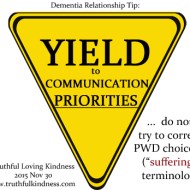
DRT: Yield to communication priorities; PWD “suffering” terminology

I have been admonished by more than one person; told that it is inappropriate for me to use the term “suffering” in connection with my dementia symptoms … but … Each of us SHOULD be allowed to describe our dementia symptom experiences, and describe them without fear of reprisal for the sake of political-correctness.

DST/Grief n Depression: Attitude of Gratitude

Personally, focus on gratitude does not mean that I negate or even ignore grief. Instead I mindfully lean into the grief in order to ENABLE an attitude of gratitude. I am thankful for you, dear reader. You give me hope … that these experiences can become part of resource tools to enrich the relationships that are building blocks for all community.

Holiday Confusion: Retain ROUTINE

Tru here. Winter HOLIDAYS are arriving, usually involving celebrations with family and friends, which can be very dis-orienting for us living with dementia symptoms. My dementia symptoms continually progress, but they progress very slowly.  Progression is so slow that family and friends do not see a need for change on their part.   So they ignore […]

How I Recognize Myself and Others

Biggest cues for me in recognizing sight of self and loved ones are hair length, hair color, and hair style. … But my most reliable recognition for both spouse and loved ones is not sight; it is sound, and smell. … But even when I no longer recognize loved ones … please do not pull away from time spent together. Relationships are what make life worth living.

Feeling Left Out with Dementia Symptoms

I was asked to think about what phrases and actions leave Persons With Dementia symptoms feeling left out. … Includes: Phrases that exaggerate my symptoms, Phrases that minimize (invalidate) my symptoms, Phrases that ignore my symptoms, Phrases that minimize (or ignore) my life-expectations, Actions that exaggerate my symptoms, Actions that ignore my symptoms, and Actions that exaggerate my “different-ness” or “alone-ness”.

All of these situations involve showing respect, embracing who the person is, and meeting them at their varied ability levels (because some aspects of abilities are still very high, and some quite low).