Dementia Success Stories

 PWD Success Stories 2in100ppiMy newest project: DEMENTIA SUCCESS STORIES:
“How we made a difference for self and those around us AFTER diagnosis”

A dementia brain-storming project by participants of PWD Perspective newsletter

Tru here.  UPDATE at page

https://truthfulkindness.com/dementia-success-stories/

This project had humble beginnings during a neurology appointment. “No one with dementia could possibly prepare such complete medical folder”, was what the learned specialist exclaimed after reviewing my comprehensive collection of medical reports, test results, and copies of lab work neatly categorized in two 3” binders.  Wow. CAPABLE persons cannot possibly have dementia; thanks for the encouragement! In the year since that specialist appointment, I have met many capable Persons With Dementia. The true realization just needs to be announced. “Success” can be anything from garden or craft project, to academic or dementia awareness efforts. Here is the proof that Persons With Dementia (PWD) can be capable, positive, dynamic, uplifting, motivating REAL People! Survey consists of only 12 short questions.  May or may not make your legal name available.  Answers will be compiled by Truthful Loving Kindness. Purpose: 1. To make available Dementia Success Stories initially in hard copy & continuing online. 2. To increase awareness for capabilities in early stages of dementia, to benefit newly-diagnosed PWD, family, & professionals. 3. To broaden perspective of PWD, families, & professionals. 4. To increase dementia awareness. 5. To provide contact information for peer interaction. 6. To increase application of PWD lived experiences thru including blog addresses. 7. To distribute at big international ADI conference in Apr 2015. 8. To make available to Alzheimers/Dementia organizations. 9. To make available to medical professionals and other professionals dealing with dementia issues. 10. To make available for PWD. 11. Donation-only; NO for-profit sales !! 12. Consequently hard copy distribution will be somewhat dependent on donations, because my wallet is not large enough to cover huge amount of printing and postage. Thank you to each and every one for sharing your story.  If YOU have not yet submitted info, but would like to share your story please contact me. — Tru * Admin issues: SHARE dementia awareness thru buttons below. If interested in receiving notice of future blog postings there is a “follow” button in the upper left corner (MS Explorer) or lower right (Safari and Chrome). Feel free to leave your thoughts in the form of comments, but please filter your comments with truthful loving kindness to all concerned. If there is an advertisement below, I have no control over what is shown. — Full legal name Truthful Loving Kindness copyright on 2015-01/19 MyFreeCopyright.com Registered & Protected

alzheimers best blogs badge
Healthline

Smell Hallucinations and Dementia

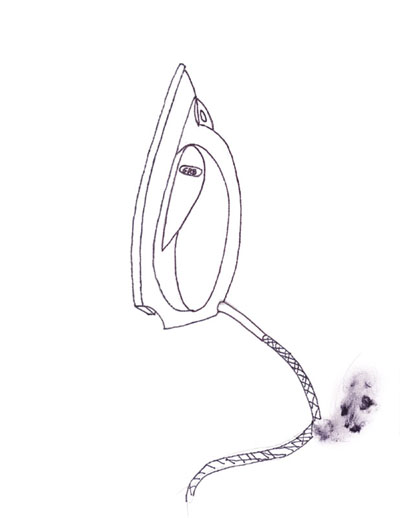
819 Blog iron 20150216a 2in200ppiTru here.  These smell hallucinations (phantosmia or olfactory hallucinations) are driving me crazy!!  Several times an hour I smell “hot” electrical wires -like a “short” in the system or an old iron with frayed cord. Been smelling this in living room, bedroom, car, etc. … Everywhere I go!

Smell hallucinations started a couple years ago with random smells like new-mown grass in the bedroom, with windows closed, in the middle of winter.

This particular “hot” smell started this Fall, and right now it is several times in an hour almost every hour!  I rarely talk about it because I have discovered that there is usually no basis for the smell.  But boy is it distracting!  Uuuuhhhhhh!!!

Mentioned to my young-onset friends.  Six out of the seven responders said they had experienced problems with “hot” or “burning” smell, either in past or currently.  Since they experienced this, two of these PWD (Persons With Dementia) have almost completely lost all smell sensations.  Seems like there should be some research on the commonality of this particular smell phenomenon, but I have never heard of any.  One patient suggested her smell hallucinations seemed to be temporarily assuaged by sniffing freshly ground coffee beans.

Like many other dementia symptoms, I think smell hallucinations can be a tremendous distraction to thought; whether productive conversation or other types of thought.  Another aspect of concern is safety.  When I smell “burning” several times per day, I automatically discount my sensory credibility.  If something was truly burning, I would not know it unless I noticed smoke, heat, or fire.  So husband is extra-careful to make sure batteries are current in smoke alarms.

Additionally; when an alarm goes off, I often have no idea where sound is coming from because I cannot remember what sounds the different appliances or gadgets create.  I check my phone, husband’s iPad, oven, microwave, etc, and then I just try to stop the noise by putting in ear plugs.

* Admin issues: SHARE dementia awareness thru buttons below. If interested in receiving notice of future blog postings there is a “follow” button in the upper left corner (MS Explorer) or lower right (Safari and Chrome). Feel free to leave your thoughts in the form of comments, but please filter your comments with truthful loving kindness to all concerned. If there is an advertisement below, I have no control over what is shown. — Full legal name Truthful Loving Kindness copyright on 2014-12/23 and 2015-01/19. (Picture by my husband)
MyFreeCopyright.com Registered & Protected

alzheimers best blogs badge
Healthline

Time Priority Adjustment and Bathtub Issues Since Dementia Symptoms

819 blog tub 4in100ppi

Tru here.  Before tentative diagnosis 2.5 years ago I had a longer “productive” life expectancy, in order to do all the things I wanted to get done.  Now that expectancy of “productive” time has been compressed along with additional, dementia-oriented set of goals such as mentoring and advocacy that are now very important to me, so attempting to achieve much much more —  in shorter realistic time frame.

At the same time, it takes longer to do even the little things like getting dressed or pouring cup of coffee.  Increase of tremors plays a part, along with much longer thought process, constant distractions, (especially increase in sound distraction, even from husband and daughter speaking quietly on the other side of room, or grandchildren happily playing) and much much longer recovery period in order to get back to where I was in my project.  Often, recovery is delayed by hours.  It becomes easy to panic because these projects are important to me.

Constant frustration of goals requires my strong stubborn streak, in ability to exercise self-control and refuse temptation for anger backlash toward my loved ones.  I have to constantly remind myself that this is about relationship with my loved ones, which has higher priority than any project.  I know that self-control will be progressively reduced, as further effects from loss of filtering process.  But I will stubbornly retain as much control over my own attitudes and actions for as long as possible.

One of the end results is sacrifice of my hour-long daily bath (except on Sunday —  & I am writing this Sunday morning).  I am just too busy to take daily time for this as an indulgence.  In the old days bathtime was my time of highest creativity, whether with pen and paper or with art supplies.  My ever-creative, romantic husband set me up with secure tub platform, glass of beverage, and project case to hold supplies.  (I am writing from tub at this moment.)  Now I mostly use computer tho.  Saves time transposing.  Saves time filing paper (which seem to never actually get filed so then efforts are lost).  And, like I say, I am running out of time, so time is very high priority.

… But these tub moments sure are nice; decadently indulgent.  😀  — Tru

PS:  Compensatory tools I use during bath time:

1)  I have developed extreme dislike for sound of water falling into tub from faucet, so I use a hose to fill tub, thus avoiding that strong splashing sound.

2) I absolutely hate feeling of randomness from water hitting my skin in shower (it feels like an attack) yet adore immersing my body in the warm water of a tub.

3) I seem to never anticipate all my supply needs such as shampoo, towels, etc, so repeated trips to gather supplies extends time needed for bath.  I need check-off sheet for supplies.

4) Once I get my hair wet, I also forget at what stage of shampoo I am; have I put on conditioner … did I rinse?  I have gotten out of tub then realized there is no hair in tub or residue of suds; I never even put on the shampoo … I only got my hair wet!  It is a problem because cannot use check-off sheet for that.  Need to remove all papers once I start washing hair — otherwise they get all wet.  Have considered some type of soap-crayons to write on tub.

5) Another problem is that I have an eczema-type scalp condition that requires topical treatment.  My hair is now dramatically breaking off near roots, so assume I fried it too many times by neglecting to set timer for scalp medicine before rinse.

So goes life; new advance of problems brings need for new compensatory tools and techniques for work-around, in order to achieve maximum desired goals in minimum time.  — same as everyone else!!  😀  — Tru  (Signing off for real this time).

* Admin issues: SHARE dementia awareness thru buttons below. If interested in receiving notice of future blog postings there is a “follow” button in the upper left corner (MS Explorer) or lower right (Safari and Chrome). Feel free to leave your thoughts in the form of comments, but please filter your comments with truthful loving kindness to all concerned. If there is an advertisement below, I have no control over what is shown. — Full legal name Truthful Loving Kindness copyright on 2015-01/11
MyFreeCopyright.com Registered & Protected

alzheimers best blogs badge
Healthline

Monthly PWD Perspective Newsletter

thru Dementia 20140829 crop copy

“See life Thru the Looking Glass of fellow PWD (Persons With Dementia) Life Perceptions.”

https://paper.li/f-1408973778?edition_id=2b314b10-949b-11e4-9a08-0cc47a0d15fd

Tru here.  “Best of 2014” PWD online Newsletter was published Jan 4, 2015.  It held 55 PWD participants (Persons With Dementia) who contributed links for written, pictorial or video material.  Index to newsletter is available at top of newsletter page.  This “Best of 2014” issue included 79 written pieces, 30 video links, and about 10 separate pictures.  Many resources in one location. New newsletter issues will now be available monthly, with subscription option in upper right corner of newsletter page. I would like the lived experiences shared in PWD Perspective to be applied by both PWD and non-PWD. Application of these experiences can enrich the relationships of all concerned. * Admin issues: SHARE dementia awareness thru buttons below. If interested in receiving notice of future blog postings there is a “follow” button in the upper left corner (MS Explorer) or lower right (Safari and Chrome). Feel free to leave your thoughts in the form of comments, but please filter your comments with truthful loving kindness to all concerned. If there is an advertisement below, I have no control over what is shown. — Full legal name Truthful Loving Kindness copyright on 2015-01/05 MyFreeCopyright.com Registered & Protected

alzheimers best blogs badge
Healthline

Recent Disconnect from Understanding Source of Dissatisfaction

819 Blog Choc IMG_4534a 3in300ppi copy

Tru here.  Been sick this week so simply posting my FaceBook status update as blog:

Feeling a bit better so back at keyboard for few minutes anyway. Want to document this feeling because seems like “lived experience” (thanks Shibley Rahman for term) should be useful to others.

Lately been dissatisfied and grumpy at times throughout day.
Just vague feeling of irritability.
Today remembered that I have been feeling this way a lot recently.
Finally (10min – hour?) it hit me that I wanted a drink.
It is not automatic anymore.

Dissatisfaction does not connect with source of dissatisfaction – just too vague.

Then I decided wanted drink of coffee.  No never caffeine but I like my chocolate coffee and didn’t have any this morning because of the extreme dizziness.  So I find coffee mug.  I know there is decaf in my teeny motel-sized coffee pot, (which I can now do myself with motel-sized pre-measured packets).

I picture mug full … but can’t remember how I get it that way.
What do I do first?
Now I remember that this is how it has been lately; not remembering how to get it that way.
uuuhhh!!!  Constant change

… as soon as you get your feet under you for a day or two, you end up on the floor again
and trying to figure out new compensation strategies.  –Tru

.

UPDATE: Now i keep a mug on table (and an additional mug on my workDesk) at all times.
Seeing the mug triggers transfer from feeling of dissatisfaction to feeling of thirst  ((big smile)).

* Admin issues: SHARE dementia awareness thru buttons below. If interested in receiving notice of future blog postings there is a “follow” button in the upper left corner (MS Explorer) or lower right (Safari and Chrome). Feel free to leave your thoughts in the form of comments, but please filter your comments with truthful loving kindness to all concerned. If there is an advertisement below, I have no control over what is shown. — Full legal name Truthful Loving Kindness copyright on 2014-12/24. // <![CDATA[ (function () { document.write(“”);} () ) // ]]>

MyFreeCopyright.com Registered & Protected

//

alzheimers best blogs badge
Healthline

PWD Experience as Resource for Dementia Professionals

819 Blog 20141221 a3in100ppi

Tru here. 2014 was the year I realized that, in an ideal world, the collective lived experience of Persons With Dementia (PWD) would be a rich resource for dementia professionals (or any person) dealing with PWD.  2014 is the year I began hallucinations, and then began Aricept prescription. Aricept much improved my hallucinations, recognition of husband, and reading comprehension for over six months.  After this increase my reading levels continued to drop and I have not increased my Aricept dosage.  By the end of 2014 my reading comprehension dropped back down to sixth grade, and then further dropped to fourth-grade level.  Awkward situation now, but I can write better than I can read, so I lost much ability to edit what I write.

During 2013, I spent many hours looking for PWD blogs.  I found a few, but most were inactive.  Left some messages but no one ever responded.

During Springtime 2014 I started realizing what a rich resource this information is.  For fellow patient, caregiver, or professional, narratives from “lived experiences” of collective PWD should better prepare anyone interacting with individual PWD.  Astute caregivers and medical professionals will recognize benefits from descriptions of Lewy Body hallucinations, vividly dramatic dreams, pinball-effect of sound and light, characters and creatures produced from coloring and texture of coverings for walls floors and windows, and other daily events.  Wise persons can APPLY these “lived experiences” in their daily interactions with persons who are no longer able to easily communicate.

Frustration: I became part of several groups for mixture of patient and “caregiver”, but they held comparatively few patients.  I learned why.  Often mixed groups appear to be a safe venue for venting “caregiver” frustration, but little APPLICATION of lived experiences from other patients takes place.  The dementia patient experiences little peer support, and is not really able to impact care of other patients, multiplying their frustration.  I dropped my membership in those groups.

Frustration: Stigma-induced attitudes and terminology triggered my comments at newspapers, magazines and webpages, but were often never approved, adding to my frustration.  However, it is a good thing I did this reading and commenting while I could, since my reading comprehension further dropped during 2014, largely preventing my understanding of most news articles now.  To top it all off, it felt like I was the only person on earth (PWD or non) who was interested.

Frustration: The PWD text group did not want to hear about my advocate efforts.  Not only were they not interested, but they were offended by “self-promotion” if people linked a personal blog or current project.

I was part of an organized video “support group”, but they were not interested either.  During weekly update round-robin for that support group, it was clear that even two sentences of my current advocate efforts were two sentences more than enough.  I can’t complain.  It is just that no one else was truly interested; it was not important to them.  I don’t want people to pretend interest just to be nice!  Since I couldn’t really talk about my current activities I re-directed my efforts to projects.

PROJECTS:

1.  Blog:  Began my blog http://www.truthfulkindness.com on July 12.  I paid for a year’s use of blog webspace at that address.  This blog has a rather specialized interest audience.  It has been over ten years since I became disabled so I had no friendship base from which to pull readers.  Consequently blog readership is still comparatively low with ~240 viewers per week.  However, my personal perspective is that who knows what wise decisions will come from those particular readers, in part from factor of what they read in my blog?  The number of readers is not crucial, but those decisions and alteration of attitude may be.  I feel very good about productivity from my blog.

2.  Newsletter:  ((link below))

https://paper.li/f-1408973778

It wasn’t until summer that I began gathering blogs of other PWD into weekly newsletter titled “PWD Perspective”.  I paid the fee for one year in order to enable ability to work in draft format and web-publish in an ad-free environment.  The first few months were very encouraging, with readership between 50 to 80 per week.  But I could not continue that huge investment of time and effort.  As long as I sent individual Twitter links for newsletter to each recipient who showed interest, each week, I continued to get responses of how helpful the blogs were, etc.  But they did not subscribe, so when I quit sending individual links for each newsletter, readership dropped to 10% of that number!  Considering the hours in prep-time each week, why continue herculean efforts shouting to only wind and trees?  Modification was clearly needed.  Different preparation techniques are now planned for 2015 requiring much fewer hours, and frequency will be monthly instead of weekly.

3.  FaceBook:  Since so many of my friends are active on Facebook, but do not blog, I also began gathering FaceBook updates for my friends into “PWD Perspective”, but FaceBook recently deleted that account.  FaceBook offered to transfer information into either “page” or “group” status, but neither of those formats worked for this purpose.  FaceBook project seemed to have a nice response during the months that it was operational, so this was quite a disappointment.

4.  Public Speaking:  Submitted abstract for oral presentation at 2015 ADI Perth conference.  We will see what happens with that project, but the possibility is exciting.

5.  Memoirs:  Still have not given up on the idea of someday publishing my memoirs, but have not worked on them much this year.  I have not had time, with my advocate efforts as priority.

6.  Personal:  Now have craft room available, but no time to devote to my craft projects … yet.

So you see I have stayed very busy with advocate issues in 2014.  Some projects are small but clearly productive, and some appear not-so-productive right now.  But one day soon, astute “caregivers” and medical professionals will recognize rich resource from descriptions of PWD lived experiences.  They will apply lived experiences of other patients to their own current PWD relationships, and those relationships will blossom as a result.  Since relationships are what makes life worth living, THAT is a very big deal to me! — Tru

* Admin issues: SHARE dementia awareness thru buttons below.  If interested in receiving notice of future blog postings there is a “follow” button in the upper left corner (MS Explorer) or lower right (Safari and Chrome).  Feel free to leave your thoughts in the form of comments, but please filter your comments with truthful loving kindness to all concerned.  If there is an advertisement below, I have no control over what is shown. — Full legal name Truthful Loving Kindness copyright on 2014-12/21. // <![CDATA[ (function () { document.write(“”);} () ) // ]]>

MyFreeCopyright.com Registered & Protected
alzheimers best blogs badge
Healthline

Verbal Comprehension Strategies Part 1

819 Blog commun ECT 5in200ppi

Tru here.  Please remember I can only speak for myself.  Dementia is not one-size-fits-all !
My problem with communication is once I lose track, everything after that starts to crumble.
The following suggestions may help me stay on track and participate in conversations at least in this early stage.

This is my Holiday gift (Chanukah, Christmas, etc) to my own loved ones & those of my friends.

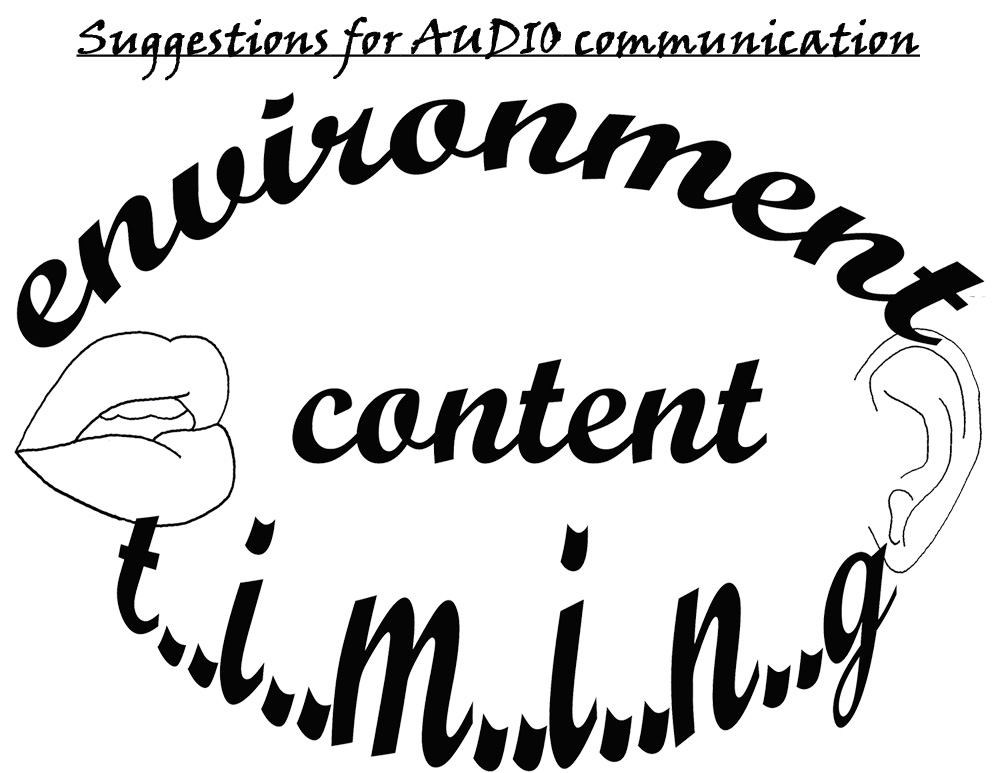
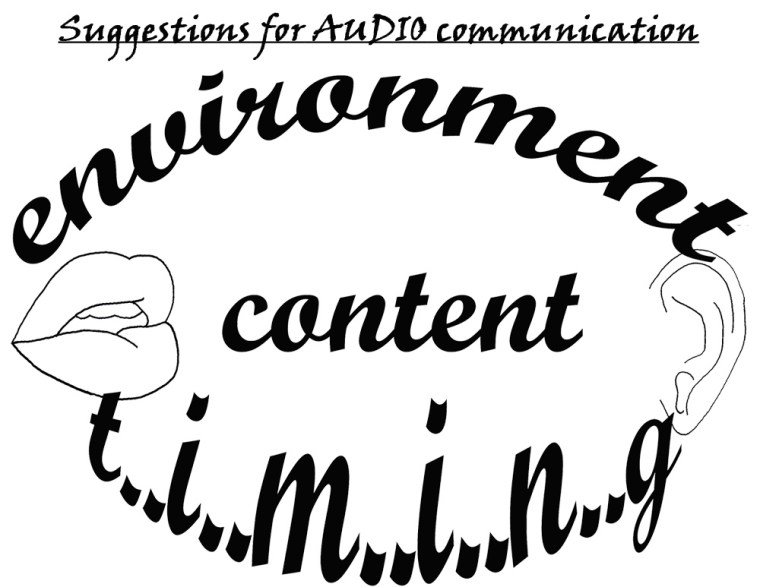
Outline for E.C.T. (Environment, Content, & Timing for Conversation)

Environment:
….A) Visual;
……..1) Make eye contact; note “Positive Physical Approach”;
……..2) Mouth visible;
….B) Reduce background audio and visual “noise” of environment:
……..1) Single person speaking;
……..2) Avoid startling or loud noise;
……..3) Avoid “background” noise (audio and visual);
….C) Bring person or activity to help carry conversation;
….D) Be aware of “invisible” distractions:
……..1) Health
……..2) Hallucinations

Content:
….A) Grammar/Vocabulary:
……..1) Reduce extra phrases and clauses;
……..2) Consistent use of past/present/future tense;
……..3) Use proper names (eliminate he/she/it/they);
……..4) Consistent person-use: Me or you or he-she
……..5) Avoid double negatives
….B) Avoid “Building Block” conversations with progressive thought concepts;
….C) Encourage with thoughts and actions
……..1) Avoid denial or trivializing
……..2) Check “Language Guidelines” to avoid hot-button terms.
……..3) Suggestions

Timing:
….A) Adjust your rate of speech to my own speed;
….B) Allow time in between sentences and change of subject.  Allow interruptions.
….C) Consider time of day or recent energy expenditures

DETAIL for E.C.T.: (Environment, Content, & Timing for Conversation)

Environment

 ….A) Visual;

 1). Make eye contact: Without eye contact I may not know I am being spoken to, therefore I am missing out on the first part of conversation.  Check out Teepa Snow’s “Positive Physical Approach” techniques at teepasnow dot com or link with detailed handout at:

http://www.alz.org/georgia/documents/communication_handouts_-_revised_11-08.pdf

2). Mouth visible: Make sure I can see your mouth when speaking, in order to help put together audio puzzle of sounds into words and sentences.  Like many Persons With Dementia (PWD), I have a sound-processing disorder.  The sounds scramble and brain has difficulty putting the puzzle together.  This makes telephone conversation extremely difficult.  If you use insufficient enunciation, it further blurs actual sounds, compounding the problem.

 ….B) Reduce audio and visual “noise” of environment:

 1). Single person speaking; avoid simultaneous speakers.
2). Avoid startling or loud noise; Any loud or startling noise has pinball-effect in my brain, which is extremely distracting from remembering subject, noun, and verb, in order to pull your sentence together.  That “noise” can also be visual surprise, such as a child moving quickly – or even visual clutter.  Movement is more intense distraction than stationary sight.  Intense color contrast gives more distraction than many things in solid color.
3). Avoid “background” noise: Any distractions are huge problem with communication.  “Background clutter” noise of radio, TV, (or even water faucet) compounds the puzzle of your words because my brain has difficulty knowing which sounds come from which source – they are all mixed together.  Visual distraction can also be extra loose objects on table or floor.

 ….C) Bring person or activity; Do not expect sustained conversation with me.  Bring one or two friends who are willing to move slowly & speak slowly.  You can chat in my presence – letting me just speak up occasionally rather than requiring me to pull one-half of conversation.  Or maybe we could “chat” while doing something else, lessening my burden for carrying a conversation, like while walking, or gathering firewood, or washing dishes even.  Yes, I need to see your mouth moving when you talk, so look at me when speaking, but that gives me something to do so there is not an awkward silence while I try to match some words to the concepts floating around in my head.  We could fold laundry or take a walk outside, put together a puzzle or I could crochet while you work on a different project.  Pictures of people & things are great ideas also.

 ….D) Be aware of “invisible” distractions:

 1). Health: Other distractions can be as simple as a drippy nose or trying to keep something “in the back of my mind”: the stove is still on, the dog needs to go potty, I need to go potty as soon as I finish wiping my nose, etc.
2) Hallucinations: I am already experiencing hallucinations, which are very common with Lewy Body Dementia.  Others experience them almost every waking hour, and may be trying to focus on your words, despite trying to ignore creatures flying at them, or (for me) bugs that I see on your skin.  We have experience and cognitively understand that these things are not real, but you know the saying “seeing is believing” … and it is very distracting to conversation.

Content:

….A) Grammar/Vocabulary:

1). Reduce extra phrases and clauses: Makes it easier for me to connect subject with verb.  I am most likely to remember first phrase in your topic … and the last phrase;  most of what you have sandwiched in the middle is lost.   Avoid descriptive monologue, where something is being described.  Often that description becomes the only thing I remember; I have forgotten WHAT is being described, WHY it is being described, and HOW this description fits into your larger topic.  Usually I have forgotten the larger topic all together!
2). Consistent use of past/present/future tense; less confusion.
3). Use proper names (eliminate he/she/it/they); I forget who/what you are speaking of.
4). Consistent person-use: Don’t jump perspective from Me to You, or to he/she
5). Avoid double negatives.

….B) Avoid “Building Block” conversations with progressive thought concepts: (Here comes the conditional clause.) IF I have problem with a simple conditional clause (if>then) in single sentence, THEN it stands to reason that there is little chance I will grasp consecutive paragraphs using building-block concept.  You lost me on the second step because brain must still keep concept of step one in mind, in order to understand step two – and I have already forgotten step one by the time you get to step two.  I have probably lost our topic all together.

 ….C) Encourage with thoughts and actions

 1. Avoid denial or trivializing: Please do not tell me how you have similar problem to my dementia symptoms, unless you actually DO have dementia symptoms! Normal forgetfulness is not dementia, and trivializes my reality.
2. Check “Language Guidelines” to avoid hot-button terms.  Kate Swaffer lists generally-accepted guidelines http://kateswaffer.com/2014/09/10/day-10-dementia-awareness-month-language-guidelines-2014/ and I discuss my particular pet-peeves at https://truthfulkindness.com/2014/11/17/consumer-terminology/
3. Suggestions: I don’t NEED you to feel the same feelings … or to pity me.  Both of us must accept the pain and grief, but I may need encouragement.  You can ask, but I will probably NOT have ability to think of activities that would be helpful; you need to do that.  You could drive me to my spiritual congregation, pick up groceries, walk with me, sit and crochet while watching the sunset, … or just give me a hug.

Update note: I think PWD blogs (many available at https://truthfulkindness.com/about/links/ ) are a very good means of moving sympathy (caring/understanding for suffering of others) into a degree of empathy (ability to experience the feelings of another).  I don’t believe true empathy for PWD is possible, because dementia symptoms create such a strong filter for our experiences that without physically enduring those symptoms yourself, you are UNABLE to “experience” them.  Patient can be very good at explaining, but, as any professional knows, nothing substitutes for experience.

Timing:

….A) Adjust your rate of speech to my own speed; Some listeners may be offended if you slow down your speech.  I suggest you use my current rate of speech as guide, because my processing speed can change even hour to hour with some types of dementia.  Unless feeling a lot of pressure, I generally do not speak faster than I think.

 ….B) Allow time in between sentences and change of subject; Please do not rush into next sentence – especially not into next topic; give me time to digest what you said, and maybe compose reply.  PWD may not remember what they want to say long enough to wait for break in conversation. Allow interruptions.

 ….C) Consider time of day ** or recent energy expenditures; especially if patient is experiencing lack of sleep (like me) or un-refreshing sleep, then recent “show-time” expenditures, such as doctor appointment, visitors (or even phone conversation because phone can be so stressful when cannot see speaker) or unusually strong efforts to function “normally”  could cause extreme confusion or exaggerate other symptoms for some time afterward.  These factors need considered in communication timing.

 Transparent, thoughtful communication is at the base of every relationship in life, and relationships are what makes life worth living.  At some time in future, hope to blog suggestions for written communication and non-verbal communication.

Author Note: This article began with my words, now found under “Detail” heading.  Then husband HELPED me categorize (he did not DO it; he helped ME to do it) and distilled suggestions from each point of my observations.  It is no longer easy for me to step back from my own experiences and create generalized application.  Someone with intact brain function needs to do that.  These efforts took approximately 25hrs in six days to complete written portion, in order to begin graphic.

Related Notes Update: excellent examples of non-verbal communications at

https://community.scope.org.uk/tips/non

**=  Update: Further “Timing” details regarding time of day considerations can be found in blog article by Elaine M. Eshbaugh, PhD, Associate Professor of Family Services & Gerontology at the University of Northern Iowa:  https://welcometodementialand.wordpress.com/2015/08/24/the-prime-time-in-dementialand-and-why-i-dislike-afternoons/

—  ***  —

FOLLOW-up: Part 2 is intensification of symptoms
>> https://truthfulkindness.com/2018/12/31/floating-words/
… and Part 3 is here >> https://truthfulkindness.com/2019/10/20/verbal-comprehension-strategies-3/ .

* Admin issues: SHARE dementia awareness thru buttons below. If interested in receiving notice of future blog postings there is a “follow” button in the upper left corner (MS Explorer) or lower right (Safari and Chrome). Feel free to leave your thoughts in the form of comments, but please filter your comments with truthful loving kindness to all concerned. If there is an advertisement below, I have no control over what is shown. — Full legal name Truthful Loving Kindness copyright on 2014-12/14.   Tags: dementia, conversation, talk, best (#1 best of 2014)

MyFreeCopyright.com Registered & Protected

alzheimers best blogs badge
Healthline

PWD Leadership in My Own Life During 2014

Tru here.

What does a leader of PWD (Persons With Dementia) look like? Collins dictionary says a “Leader” is the first person on the climbing rope. It is the first animal in the team, or the first section of blank film or tape into the projector or machine. Vocabulary dot com says it is the person in charge who convinces other people to follow. Noun of “leader” is the one or thing who is executing verb “to lead”. I think that the most effective leader will lead by example. He or she is the one I see in front, with other folks following. The leader will guide others on a specific path, instilling the leader’s vision in those others who travel on toward that same goal. “Leader” = one who leads; is first on path. Can’t lead from a different path; that is “coaching”. So leader of PWD is exclusively another PWD.

Harry Urban

In my personal path as person living well with dementia symptoms, the leaders I first followed were my maternal grandmothers; remembering their symptoms and how they handled those symptoms. Then I was introduced to Harry Urban and his participation in project of “Dementia Mentors”. As the name implies, this project is by nature a leadership project, using internet as transportation to lead other PWD (Persons With Dementia) in the path of living well with their dementia. What an inspiration Harry is! He leads by example and was a founding member for this wonderful project of teaching other PWD to also become leaders-by-example.


Effective a few months ago, Harry is no longer involved with the “Dementia Mentors” project, but the project continues (Link at bottom of page). With the assistance of a few non-patients (Gary, Michael and Delores) who provide needed continuity during the natural turnover inherent with dementia patients, multiple Persons With Dementia (PWD) have banded informally together to lead by example as Dementia Mentors.

Robert & Judy Bowles

Susan Suchan & myself

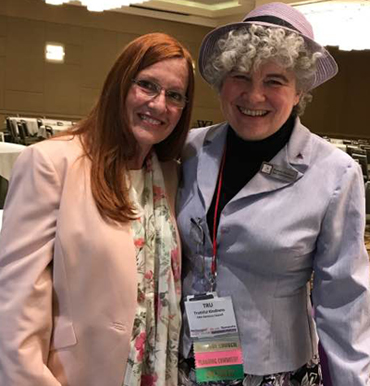
The two who most inspired me in my recent journey are retired pharmacist Robert Bowles (with Lewy Body Dementia) and retired RN, Susan Suchan (with primary progressive aphasia, which is a form of Fronto-Temporal Dementia). These are the ones I constantly rely on as fellow-leaders on the path with me. We chat in both text and visual visits thru a webcam; casual get-togethers of friends visiting friends at their homes. I talk with them from my living room while I see them talking to me from their living rooms (or sometimes Susan takes us outside on her laptop while she is talking). At times, Susan is even dressed in her bathrobe as she uplifts the lot of us with laughter in her halted, slow-tempo speech. This makes us all feel comfortable to join in, no matter what we happen to be wearing; we don’t need to be “dressed up” or have our make up on in order to join the conversation. I mostly join in on Thursday nights, but there are gatherings most every day of the week, and we can make arrangements for any time of day. Thursday nights can include other family members. Other nights are PWD-only (except for one non-patient available for technical assistance) in order to provide the security of privacy for patient discussion.

In addition to multiple Memory Café groups during the week, Dementia Mentors has weekly short and empowering recorded videos (I personally have made two of them) instructing how to rule your disease. These recorded videos are also excellent for persons other than patient, in order to understand the dementia patient’s perspective. One-on-one mentoring for newly diagnosed patient is also offered through confidential video chat.

Dementia Mentors has no formal organizational structure, which provides maximum freedom in participation. Only a few rules exist, such as “no medical advice is given”. Our methods of living well are not identical because each person is different. We all have different motivations, with differing skill sets and talents. For each of us those abilities are largely progressively declining, so we are constantly requiring new compensatory techniques and tools. I am messenger; I mostly use written words and my mission is to spread the perspective of Persons With Dementia (PWD) to teacher, dementia coach, author, researcher and doctor. I believe this PWD Perspective can be very useful in the execution of their daily tasks.

Lauren U uses art to share her experience of living life with Lewy Body Dementia. Gord Settle uses photography. We have several retired doctors including David Kramer, who shares his life from a FaceBook page called “Living Well with Alzheimers”, and Jennifer Bute who spreads the message using videos and pamphlets from her website “Glorious Opportunity” dot org. Barry was a gourmet baker, and lives in Indonesia. Ann is in Scotland. Chris is in Wales. I live in America. We are about 50 members and come from all walks of life and all parts of the world.

Those in Dementia Mentors are not the only Persons With Dementia (PWD) inspiring other PWD to live well; far from it! It is simply the only group I know of who specializes in bringing each person on the dementia path into the position of being a leader for other PWD. As such, these people are the leaders of the leaders.

Dementia Mentors is not the only internet PWD project I am involved in; Dementia Alliance International dot org (DAI) is a not-for-profit structured organization designed by, and for, Persons With Dementia (PWD). In my perception, DAI has outward focus more than as project to provide leadership for other PWD; specifically-defined PWD support groups are provided, but I see their organizational goals as much larger than that. They are not training leaders for PWD (Persons With Dementia), but inspiring PWD as spokespersons to the world. Theirs is another story. 2014-12/05 from 1am – 5am.

click here >> https://www.dementiamentors.org/

* Admin issues: SHARE dementia awareness thru buttons below. If interested in receiving notice of future blog postings there is a “follow” button in the upper left corner (MS Explorer) or lower right (Safari and Chrome). Feel free to leave your thoughts in the form of comments, but please filter your comments with truthful loving kindness to all concerned. If there is an advertisement below, I have no control over what is shown. — Full legal name Truthful Loving Kindness copyright on 2014-12/05.

MyFreeCopyright.com Registered & Protected

alzheimers best blogs badge
Healthline

Quotes Nov 2014

Thx 20141127b 6in300ppi

Tru here.
Truthful Loving Kindness is thankful for family of ALL sorts (including “family” on computer).  This year especially thankful for others who have dementia symptoms and are transparent enough to share their experiences.  These excerpts have either been written specifically to share, or found in public format of blog, Facebook or Twitter.

Anonymous PWD friend 15 Sep 2014: “I have some advice for caregivers with loved one experiencing hallucinations.
1) Exelon works great for me.
2) Remove items from the room that your loved one is having trouble with — belts become snakes – laundry moves and becomes people, etc.  … For me it’s ordinary items left out that can become something else.  Other times things just appear out of nowhere!”

Barry Pankhurst 2014 Nov:
All I want for Christmas
is to be the way I used to be,
with the acquiescence of body and mind,
and the spirit of a bird that flies free
to walk the pathway of life once more …

Chris Roberts 19 Nov 2014:
It’s Christmas!
Joy and laughter, presents and snow
Turkey, crackers, hats and cake
Children playing, noise and fuss …
Stressed and anxious, feeling low
Shouting and music, nowhere to go
Staring, eyes open, tears they flow
Pacing, talking, walking and walking
Heart racing, pounding, I now feel sick
Head spinning and hurting!
It’s Christmas I think.
© chrisroberts

David Kramer posted 16 Nov 2014: ” … it wasn’t easy. Death sentences seldom are, and they tend to throw a wrench into the whole “just live every day to the fullest” idea. … Tiffany told me to cut the “sad crap” and start enjoying every day we have left together. That was the best advice I have ever received. …”

Deborah White Cunningham (wife of PWD) wrote 14 Sep 2014: “Hubby told doctor in no certain words that they are not hallucinations – it’s mirages. Doctor was taken aback by it, so I explained that … easier for hubby to understand it better if I call the hallucinations “Mirages”. … What he and I believe is that “mirages” is something he has known, and the word isn’t as scary.”

George Rook posted 10 Sep 2014:
“Ask me. Listen to me. Work with me.
Invest a little in me now, Save a lot later
and help me live well with what comes my way.
My long term conditions.
My life.

George Rook posted 16 Oct 2014:
” … When the jigsaw
floats apart
… and you just can’t quite get it
back
together.”

Harry Urban posted 22 Sep 2014:
“I try to teach them to dance in the rain
and how to ride out the waves.
It can be done
because I am doing it.
Life is never easy with or without dementia.
It all depends in how you want to live your life.”

Kate Swaffer 16 Sep 2014:
“Treat the symptoms of dementia as disabilities,
then find strategies to help live well with them.”

Kate Swaffer12 Nov 2014: “Personally, I think the people who need managing most often
are the staff of those people with dementia in their care …”

Ken Clasper 12 Nov 2014 excerpt from “The Media and Dementia”:
“… In some cases we have a lot of control as to what is written, where in many others, it’s all down to the reporter or the editor, who may well be out just to get a hard hitting story. I have had the benefit of both sides of this coin, and where the good reporter and editor write your story, so that it’s what you have said, the bad one will rewrite it to get the bad side or negative side of dementia and sadly we see a lot of this these days. This to me proves that many simply use us to get a story, where others are genuinely interested in putting out a good positive story about dementia. …

… While it is good to use the media we must ensure that they are high quality, know about dementia, and are prepared to go that extra mile to ensure the story is correct. Using the media can be very helpful in raising awareness of dementia, but we must make sure that the bad press are filtered out and not allowed to cover our stories. …”

Marion James 19 Nov 2014:
“Hi! My name is Marion James. I am the face of Dementia. I don’t look sick either. I feel like I can still do most things. I can’t drive anymore. My husband has to take me everywhere. He also has to give me my meds. I can’t remember them. I can’t remember what day it is or when my appointments are. Sometimes I can’t remember my coworkers names. I find this all not acceptable. But I keep trying …

Michael Woods 17 Sep 2014:
“Arose this morning aware of the man that I am not,
then forgot the man that I am.
Not an existential crisis,
no panic,
just a state of being
of what it is to be me.”

Robert Bowles re Lewy Body Dementia (LBD) on 17 Sep 2014: “I like to call LBD the disease of many faces. When I wake up in the morning, I never know which face I will be wearing. Throughout the day that face may change many times. The new face may last minutes, hours, days or weeks. I just have no way of knowing. Take a minute to imagine the fastest and highest roller coaster you have ever been on. With LBD, the changes may be slower or faster; and they me higher or lower. We just never know. For me there is one thing that is always constant … My God will supply all my needs.”

 Terri Gadal posted 08 Jun 2014:
I’ve Moved On:
“I slipped away,
and moved on …
Somewhere along the way
awaits another destiny …
I’ll go with it hesitantly,
until I forget and get over
this aging tragedy …”

Tommy Dunne (expert at “one-liners”) 28 Nov 2014:
“My brain is like the Bermuda Triangle; information goes in … and it’s never found again.”
“People ask me why I talk to myself.  I tell them, “Sometimes I need expert advice.”
“Enjoy life; it has an expiration date.”
“The trouble is, my train of thought often leaves the station without me.”

Truthful Loving Kindness 21 Nov 2014:
“… I know you do not see the need to make this a priority in your own life, … yet,
but if you want to be able to “reach” me next year, and the year after,
then these are necessary.  …

Please learn dementia communication techniques NOW while I can still participate in the learning;
while I can gain confidence and security that you have tools
to continue communication in the next couple years … when I cannot.
Otherwise I am alone in the “crowd” of my own family,
terrified of misunderstandings in the coming years.
And screaming to be heard.”

* Admin issues: SHARE dementia awareness thru buttons below. If interested in receiving notice of future blog postings there is a “follow” button in the upper left corner (MS Explorer) or lower right (Safari and Chrome). Feel free to leave your thoughts in the form of comments, but please filter your comments with truthful loving kindness to all concerned. If there is an advertisement below, I have no control over what is shown. — Full legal name Truthful Loving Kindness copyright on 2014-12/01.
// <![CDATA[
(function () { document.write(“”);} () )
// ]]>

MyFreeCopyright.com Registered & Protected
alzheimers best blogs badge
Healthline

Please Do This for Me

616 Blog PlzFollo 3in300ppi
Tru here:
The feeling of being surrounded by people
— but people so very DIFFERENT than I —
is loneliness … in a crowd of loved ones.

I APPEAR to be just my normal self.
No huge changes are visible.
All changes are beneath the surface.

You do not see change in my actions
so you assume no need to change YOUR actions.  … Yet.
— NOT TRUE — !

But even if you ask
I am not able to tell you in words.
… My words are not here.

My thoughts go around in circles — fragmented beyond retrieval.
Appearances are deceiving,
so YOU are the one who needs to take action:

I am consistently losing more ability to write,
but currently that is the best way to see what is going on,
for ideas on how to best participate in my life.

I know you do not see the need to make this a priority in your own life, … yet,
but if you want to be able to “reach” me next year, and the year after,
then these are necessary.

Please learn dementia communication techniques NOW while I can still participate in the learning;
while I can gain confidence and security that you have tools
to continue communication in the next couple years.  … when I cannot.

Otherwise I am alone in the “crowd” of my own family,
Terrified of misunderstandings in the coming years.
And screaming to be heard.

1. Listen to Teepa’s 15-minute introductory video at


2. Read my blog; start in July and catch up to today. (or go to “crucial” category at bottom of page & click each title to read only 16 entries).
3. Sign up to “follow” blog so you can receive email when I write update.

* Admin issues: SHARE dementia awareness thru buttons below. If interested in receiving notice of future blog postings there is a “follow” button in the upper left corner (MS Explorer) or lower right (Safari and Chrome). Feel free to leave your thoughts in the form of comments, but please filter your comments with truthful loving kindness to all concerned. If there is an advertisement below, I have no control over what is shown. — Full legal name Truthful Loving Kindness copyright on 2014-11/21.
// <![CDATA[
(function () { document.write(“”);} () )
// ]]>

MyFreeCopyright.com Registered & Protected

alzheimers best blogs badge
Healthline