Quick summary of this blog entry:
Regarding restriction of term “suffer” in connection with the dementia experience, continued from earlier blog this week (link bottom of page).
- I agree with the goals for this language guideline; to prevent stigma of profiling the dementia diagnosis as instantly totally debilitating and characterized by life-style of trauma
- I question productivity of attempt to change definition for term “suffer” in meeting this goal, which has become the red flag of conflict.
- It seems current attempts at language guidelines are in a no-win WAR with un-productive polarization of views within community of Persons With Dementia (PWD) … and also within support, care-partners and journalistic sector, … and rampant antagonism due to mis-understandings in both communities. But I don’t think dropping this project will rectify the antagonism that has now developed.
- So in order for the “suffer” vocabulary change to succeed, I think we need to come up with some method of communicating what people are seeing now as only the “small print” — the details which are sometimes un-written.
PERSONALLY, this is currently how I see these details that need communicated (in Dec 2015 but subject to change as have not discussed with anyone else, and hope to avoid this subject again for a long time):
A. We recognize this is a change to the dictionary definition of verb “suffer”, but feel the results may be worth the effort, in order to prevent stigma of profiling the dementia diagnosis as instantly totally debilitating and characterized by life-style of trauma.
B. Gather support from medical community to exclude ALL medical conditions in definition of “suffering”, as merely from having the condition.
C. We are asking the rest of the world to eliminate their use of term “suffer” from “dementia” vocabulary, but persons with dementia symptoms still have the freedom to describe their own symptoms in any way they see applicable to self.
D. We are not denying existence of various types of pain and unpleasant events (financial, social, emotional, etc) in the dementia experience, merely stating that each experience of pain or unpleasant event is different for each person, and each person is different in how they react or respond to the various types of pain and unpleasant events.
… * … * …
Full Blog Entry:
Tru here. Hoping to clarify my blog from earlier this week, and maybe eliminate some misunderstandings. The two blog entries this week are the first time I have addressed subject of “suffering” terminology since 9 months ago in February, with https://truthfulkindness.com/2015/02/24/dementia-change-priority-pathways/ , where I included one paragraph on the subject, beginning with the following statements: Don’t get me wrong; yes, I “suffer” from my dementia symptoms. And please do not complain about me using that term; as a Person With Dementia I personally am the ONLY person who has the right to say whether I suffer from my dementia symptoms. … ((At that time I was under the working diagnosis of “dementia” but that working diagnosis was later changed to Mild Cognitive Impairment –MCI.))
The reason I said that is because shortly after my tentative “dementia” diagnosis, I had been admonished (maybe 2013 ?) by a couple folks for using the term “suffer” in connection with my own symptoms, along with correcting me for inappropriate use of the term “patient”. So I researched origin of these restrictions. It was all very confusing and I am still not able to remember all the new “rules”. The primary result of these admonishments was that I was more reluctant to speak in public, for fear of forgetting or mis-application of the new politically-correct terms.
It is easy to understand why others would feel need to admonish – they generalized (mis-understood?) this instruction as saying:
1. Collectively, the majority of Persons With Dementia (PWD) are offended by term “suffer”. (Personally I think this is a misunderstanding of guidelines, since I don’t think any current PWD gathering has the ability to represent “majority of PWD”; that would be a gigantic undertaking, as I explain at bottom of this blog entry. Mostly these guidelines represent opinion of small groups of Persons With Dementia, and there is far from universal agreement on them.)
2. Collectively, majority of Persons With Dementia (PWD) believe that they do not experience “suffering” events of any type from their dementia symptoms; physical, mental, emotional, social, financial; no “suffering” occurs. (Personally I think this is a misunderstanding of guidelines … but often unclear.)
3. The term suffering should not be associated with the dementia experience, either in written or verbal form, by anyone. (Again, personally I think this is a misunderstanding of guidelines, because I believe PWD speaking of their own lived experience was meant to be an exception.)
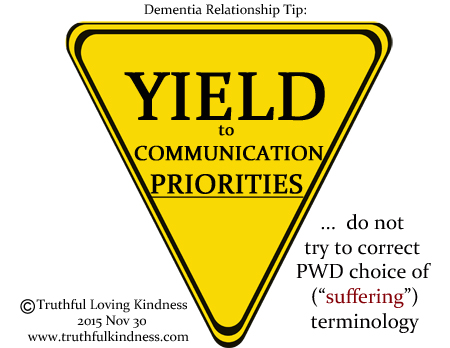
Among PWD, just as the rest of public population of the globe, there are many different perceptions of the verb “to suffer”. While growing up, my father had a hobby for dictionary and encyclopedia, so we frequently addressed them as resources. Expectation was that vocabulary usage would comply with dictionary definitions. I opened blog entry from earlier this week with dictionary definition, so will not belabor the point. https://truthfulkindness.com/2015/12/01/drt-yield-communication-priorities-pwd-suffering-terminology/
Lately I have discovered several PWD perceptions of term “suffer”:
A. Limited to experiencing physical pain (not including mental, emotional pain, etc).
B. Limited to the (voluntary or involuntary) reaction or response to those unpleasant or painful events of life (not the events themselves).
C. Physical, mental or emotional events that are unpleasant or painful (but not medical condition).
D. Unpleasant/painful events in any type of categories (physical, mental, emotional, social, financial, etc) OR a medical condition — whether involving unpleasantness or not.
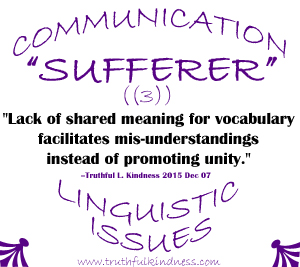
This last perception most clearly matches dictionary definition for “suffer”, and thus for the noun use of “one who experiences suffering” = “sufferer”. All persons have a different perception of words, with large variation in location and culture, thus the need for dictionaries. And so goes the changing nature of language when language usage changes — especially when we are talking about a large landscape like the full globe.
Early in my dementia experience, I was part of a PWD conversation for subject of terminology to find out what the CURRENT thoughts were in this particular group of Persons With Dementia (PWD). After listening to others, when opinions were asked for I really wanted to speak. But I had not prepared a statement for my thoughts on the subject (so it would have ended up unproductively scrambled and no one would understand what I was talking about) and PWD emotions were so strong in the meeting that I was unwilling to create conflict – so I kept my mouth shut and went with the flow. I guess they call that “peer pressure” and wonder how many others were thinking the same thoughts. I understand goals and rationale of the language guidelines. It’s just that personally I am not in the least offended by dictionary meaning for term “suffering”. I think it an appropriate term and am concerned that this action might create a no-win result. I AM offended by several other terms, but recognize that as my own problem with my own perception of language. https://truthfulkindness.com/2015/07/07/feeling-left-out-with-dementia-symptoms/. I know there is large disparity in local or cultural usage of terms, and question the productivity of attempt to change vocabulary on a global level. Despite that fact, I was one of the contributors toward USA DAA document http://daanow.org/wp-content/uploads/2015/09/Living_Fully_with_Dementia-Words_Matter__9.9.2015.pdf in July 2015.
Currently, I think the language efforts to eliminate use of term “sufferer” are counter-productive, but in large extent due to mis-understandings of those guidelines. I think this attempt might be more successful if it was bluntly recognized as an attempt to change the definition of term, and support was gathered first from medical community to exclude ALL medical conditions as “suffering” merely from having the condition (category number 2 in definition for each of the three dictionaries I checked online). The term “suffer” now seems to be creating a red flag of un-productive polarization and rampant antagonism, I think mostly from mis-understandings. The perception is that the guidelines are implying that experience of dementia, and experience of discomfort or any type of pain are mutually exclusive, which is inaccurate — but nevertheless that is what folks think is being said. Some folks then are offended at trivialization for pain of their own dementia symptoms or their loved-ones’ experience — and other folks accept that misunderstood trivialization as fact, assuming that the dementia experience is merely a minor irritant. Either way it creates huge problems and a no-win scenario, but, again, as mis-understanding of guidelines.
The original goals of these projects are very valid concerns. The projects are creating a big stir, but I think something different is needed in order to clarify the huge misunderstandings currently created.
We cannot reverse time and undo this effort (despite my own misgivings on whether success on this effort will meet the need in any meaningful way for preventing stigma of profiling the dementia diagnosis as instantly totally debilitating and characterized by life-style of trauma). So in order for the “suffer” vocabulary change project to succeed, I think we need to come up with some method of communicating what people are seeing now as only the “small print” — the details which are sometimes un-written.
PERSONALLY, this is currently how I see these details that need to be effectively communicated (in Dec 2015 but subject to change):
A. We recognize this is a change to the dictionary definition of verb “suffer”, but feel the results may be worth the effort.
B. Gather support from medical community to exclude ALL medical conditions as “suffering” merely from having the condition.
C. We are asking the rest of the world to eliminate their use of term “suffer” from “dementia” vocabulary, but persons with dementia symptoms still have the freedom to describe their own symptoms in any way they see applicable to self.
D. We are not denying existence of various types of pain and unpleasant events (financial, social, emotional, etc) in the dementia experience, merely stating that each experience of pain or unpleasant event is different for each person, and each person is different in how they react or respond to the various types of pain and unpleasant events.
Hopefully this entry clarifies my thoughts on this subject for a while, and I can put this subject way back on back burner. I see my mission as: to reflect Truthful Loving Kindness while collecting and analyzing data about myself and my own dementia symptoms, writing about them weekly in this blog. I collect projects by other PWD (Persons With Dementia) and make various pieces of that collection available to others, both by creating pages on my blog for others, https://truthfulkindness.com/index-persons-with-dementia-pwd/ and on a monthly basis thru the online collection of links called the dementia “Symptom Perspectives” https://paper.li/f-1408973778 creating a categorized database of material for professionals to easily find PWD lived experience and opinions. Considering the extra time consumed by my own mistakes and complications from symptoms, this requires many hours of my week. When able to hold a job, my work-week was frequently 60 hours plus 2hrs transit time each day, and I am sure that I have less “free time” now than I had then (spouse agrees). Political aspects like politically-correct language are not in the top priorities for my mission, so must stay on the back burner. That is why it has been 9 months since I addressed this issue at all. And with this entry I hope to leave it behind me for many more months.
Links:
 … Part 1 of this subject:
https://truthfulkindness.com/2015/12/01/drt-yield-communication-priorities-pwd-suffering-terminology/ (with comments);
(( I think neither bullying nor quietly simmering resentment is productive to goals for co-workers in efforts for dementia awareness and inclusion of PWD voice. Since I am personally very uncomfortable with conflict, I am now working on Part 3 installment for this subject; still hoping for some unifying constructive effort that could possibly be agreed upon by most PWD at least. LOL; Not only do I dislike to participate in competitive sports, even board games feel like conflict for me … so being “in the middle” for this “debate” is very uncomfortable and actually unhealthy for my stress level.))
 …
…
…
Alz Society announcement Nov 26, 2015 at https://www.facebook.com/alzheimerssocietyuk/photos/a.137638944646.108007.8270524646/10153669215994647/?type=3&theater (with 74 comments);
 … Terms I personally find offensive:
https://truthfulkindness.com/2015/07/07/feeling-left-out-with-dementia-symptoms/;
…
DAA in USA: http://daanow.org/wp-content/uploads/2015/09/Living_Fully_with_Dementia-Words_Matter__9.9.2015.pdf
DAA in UK: http://www.dementiaaction.org.uk/dementiawords;
Australia Guidelines: https://fightdementia.org.au/sites/default/files/full-language-guidelines.pdf;
DEEP Guidelines: http://www.youngdementiauk.org/sites/default/files/DEEP-Guide-Language.pdf;
June 23, 2014 DAI webinar: Words About Words at https://www.youtube.com/watch?v=5b1pD_WSn3w;
My most recent mention of “suffering” issue (in February) https://truthfulkindness.com/2015/02/24/dementia-change-priority-pathways/;
Another interesting link (by Nick Cohen): http://blogs.new.spectator.co.uk/2014/06/the-cheating-language-of-equality/
Note: For long-range projects on “collective” opinion, peer pressure is a big concern of mine, along with individually-tailored, multi-format of address to Persons With Dementia. Yes; would love to see some kind of collective statements on language — but would need gigantically huge outlay of time and energy to come anywhere even close to that goal, because each individual’s symptoms affect communication in a different way. Some folks’ symptoms create more problems in group visual chat format. Some folks no longer have the ability to communicate well in written format, and some folks need one-on-one visual format. Other folks’ symptoms are too advanced for technological use, or they do not have access to technological tools in order to communicate easily, and then transportation issues come up. I think any type of collective statement would need to be large scale in number of participants, locality/culture of participants, and with a wide range in symptom-severity of participants. Otherwise it becomes a mixture of popularity contest and who speaks loudest with the most emotion. Neither of these options will produce a true “collective” representation for opinions of Persons With Dementia.
 10hrs on text, & 2hrs trying to recycle background graphic
from my piece titled “Damn, It Hurts !”
link at https://truthfulkindness.com/bnp/part-2/2e/1989-feb-damn-it-hurts/
;
* Admin issues: SHARE dementia awareness thru buttons below. Feel free to leave your thoughts in the form of comments, but please filter your comments with truthful loving kindness to all concerned. If interested in receiving notice of future blog postings, subscriptions are available through a “follow” button in the upper left corner (MS Explorer) or lower right (Safari, Mozilla Firefox and Chrome). If there is an advertisement below, I have no control over what is shown. My own full legal name is Truthful Loving Kindness. My current clinical diagnosis is Mild Cognitive Impairment. Text for this page took 10 hours, and another 2 hours trying to recycle background for graphic. Copyright 2015-12/03.


Healthline |
Please pass on Dementia Awareness by Sharing:

 …
… …
…