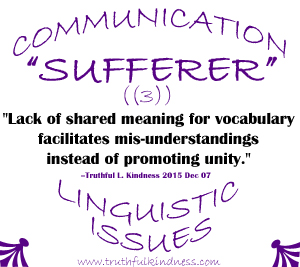
Sufferer Part 3; The Linguistic/Communication Issues

819 blog 20160202 sufferer3b 3in100ppi

Summary:
Due to widely different personal meanings,
verb and de-verbal noun of term “suffer” are
at best useless in communication, and,
at worst, they have become divisive words
in both the PWD and assistance communities.

Why is this?

…  Part 1 of this subject is here: https://truthfulkindness.com/2015/12/01/drt-yield-communication-priorities-pwd-suffering-terminology/ (with comments). Part 2 developed from conversations regarding Part 1, and is here:  https://truthfulkindness.com/2015/12/03/dementia-suffering-terminology-part-2/ , along with links to the language guidelines themselves.

***   …   ***   …   ***

Tru here.  Quietly simmering resentment is not productive to goals for co-workers in efforts for dementia awareness and inclusion of PWD voice (voice of Persons With Dementia).  I guess you could say this series on “SUFFERING” term is a peacekeeping effort.  Since I am personally very uncomfortable with conflict, this is an additional installment of Part 3 for this subject.  Clarification of subject and definition did not work, so still hoping for some unifying constructive effort that could possibly be agreed upon, at least by most of the Persons With Dementia (PWD) that I know.   Not only do I dislike participating in competitive sports; even board games feel like conflict for me … so being “in the middle” for this debate is not only uncomfortable but actually unhealthy for my stress level, thus I have delayed two months for finalizing and publishing this installment of subject.

Suspect much “stigma” is formed from misunderstandings between the involved parties, and I have become very concerned at the mis-understandings for definition of verb “suffer” in regard to dementia and mis-understandings with grammar rules, for use of the DeVerbal Noun, “sufferer”.  Additionally, suggested Language Guidelines themselves are often mis-interpreted (by both Persons With Dementia and Persons withOut Dementia) as implying that there is generally no “suffering” with dementia, and also mis-interpreted as representing the general PWD opinion.

Very few of the Persons With Dementia (PWD) with whom I have personally spoken are offended by either verb “suffer” or deverbal noun, “suffer-er”, in connection with the stigma of profiling the dementia diagnosis as instantly totally debilitating and characterized by life-style of trauma.  The largest percentage of my friends are not offended by this verb or noun.

So a few are offended on the one side.  However, I have spoken with at least an equal number of PWD who are deeply OFFENDED by what they perceive the Language Guidelines to be saying — and who consider the language guidelines as source of social stigma to those PWD who choose to make their pain and discomfort public (in my perception mostly because so much of the population without dementia symptoms is also mis-interpreting the guidelines to imply that there is generally no “suffering” with dementia).

These folks are usually less militant than my few friends who are proposing the guidelines, but these PWD feel bullied and pushed to the wayside by their fellow PWD, because there is a popular misconception that these guidelines somehow speak as representation for the majority of Persons With Dementia (PWD).

So I address this subject again now, in search of something constructive toward remedy, because I think this is becoming progressively more damaging to a substantial portion of PWD, in their willingness to engage in peer contact and share their lived experience.

Like I said before, my introduction to this restriction was shortly after my tentative “dementia” diagnosis in 2012.  I had been admonished (maybe 2013 ?) by a couple folks for using the term “suffer” in connection with my own symptoms, along with correcting me for inappropriate use of the term “patient”. My subsequent research led to the language guidelines by Alz Australia.

In my current research on this subject, I see two major problems in the polarization of PWD opinions on language guidelines, and both have to do with language itself: definition, and forms of grammar.  There are drastically different meanings of verb “suffer” and de-verbal noun “sufferer” amongst PWD.

Each understanding for definition of term “suffer”
pre-disposes to getting offended in one direction or the other
of the proposals for language guidelines on term “sufferer”.


***   …   ***   …   ***  DEFINITION  ***   …   ***   …   ***

“Both verbal and non-verbal language are very subjective means of communication, because words and behaviors mean different things to different people – but we must continue to try because communication is necessary for any relationship.” -Truthful L. Kindness 2016 Feb 02.

I don’t think I have ever called someone other than myself a “sufferer”.  Until the recent uproar about the language guidelines proposed by several small groups, I considered the “sufferer” issue a somewhat minor difference of opinion.  But now I am beginning to conclude that “suffer” is a useless term in communication BECAUSE the term often carries a large emotional aura but does not communicate at all the same meanings amongst groups of people.  Lack of shared meaning for vocabulary facilitates mis-understandings instead of unity.

  • At least one Person With Dementia (PWD) has “suffering” definition as, “If I can be happy then I am not suffering”.
  • … But that is a far different meaning than a PWD who (quite correctly from the dictionary) includes in their definition any loss of ability – quite apart from any emotional response to that loss.  This PWD figures if there is truly no “suffering” then each of us retains ability to finish each one of our prior tasks (of life or occupation) with the SAME quality, quantity, and timing in which we had been able to complete them before dementia symptoms began.  Abilities with regard to senses (sound dis-orientation, space and time disorientation) are of course included in those abilities along with all executive thinking.  According to this particular (dictionary) definition of “suffer”, most people who have any dementia symptoms would fit in the category of “suffer”, regardless of emotional context, and to think otherwise is pretending or divorced from reality (or gross mis-diagnosis with no dementia symptoms at all).
  •  …  Then, at another far other end of the spectrum are those who feel “suffer” is limited to experience of intense physical pain,
  •  … or those who consider “suffer” as limited to only an emotional REACTION (to the symptom, decreasing ability, or event of discomfort or pain).

These varied definitions above are all from my PWD friends during past 6 months.

The problem is that no one stops to discuss their particular definition of the word; they just get emotional (imagine that for someone with dementia symptoms LOL).  So there are gigantic mis-understandings because we assume we are communicating similar meaning with the word “suffer” — but it is an ILLUSION of communication because we are not talking about the same concepts !  We are comparing apples to oranges, thinking we are all talking about the same fruit.

An illustration might be reactions to sentence, “My husband is critical to this blog.”  Does that mean he is indispensable to the blog … or giving negative feedback?  The context of conversation or reader’s knowledge of our relationship would be necessary in order to gather hints for the opposite meanings of the word.  … but each reader’s personality and experiences would lend itself to one meaning or the other.

The term “suffer” has become so muddy as to be useless, due to variety of interpretation.

Even if we could agree on a meaning between our small individual groupings of a hundred here and 50 there, 200 somewhere else, or an additional 30 … that is such a small portion of the PWD population as to be negligible for representation.  And all new PWD are expected to conform to OUR newer definition of the word?  Won’t work.  Besides that, even if we could agree on what we wanted the word “suffer” to mean, if it was different from our original concept of the word, we ourselves would keep forgetting the new, agreed-upon definition by the end of the paragraph !!

Lack of shared meaning for vocabulary facilitates mis-understandings instead of promoting unity.


IF anyone chooses to use a variation of the word “suffer” it would be helpful to clarify which particular definition is being used, both before and after use of the term.

To “suffer” as transitive verb = used WITH object ((such as term “dementia”)):  1. to undergo, be subjected to, or endure (… anything unpleasant);  2. to undergo or experience (any action, process, or condition);  3. to tolerate or allow (per dictionary.com).

To “suffer” as intransitive verb = used without object:  1. to undergo or feel pain or distress;  2. to sustain injury, disadvantage, or loss;  3. to undergo a penalty;  4. to endure pain, disability, death, etc patiently or willingly (per dictionary.com).

To suffer something is, etymologically, to “hold or sustain it from underneath,” from Latin sufferre, “sustain.”

According to Merriam-Webster, the origin of “suffer” is: Middle English suffren, from Anglo-French suffrir, from Vulgar Latin *sufferire, from Latin sufferre, from sub- up + ferre to bear  

***   …   ***   …   ***

***   …   ***   …   ***  GRAMMAR/FORM: De-Verbal Noun  ***   …   ***   …   ***

Nouns describing myself (most of which are also “DeVerbal Nouns”) demonstrating variety of time connotation:

  • I am a meat-eater (frequent basis)
  •  I am a plant-eater (frequent basis).
  •  I am a walker (frequent basis).
  • I am a writer (frequent basis).
  •  I am a ballroom dancer (infrequent basis).
  •  I am a sewer and a singer (infrequent basis).
  •  I am a researcher (check out my “Ancestry” page).
  •  I am a house-designer (TWICE: designed and submitted sets of blueprints for two different two-story homes)
  • Politically, I am a very tolerant conservative (life-style).
  •  Typologically, I am a “Thinker” (One reason INTPs have that nickname is because that is often where we gain a large portion of self-value, and another reason is that it is the route we prefer to make decisions from).
  •  Medically, I am a “sufferer” for several conditions. Some have a lot of physical pain, and some have none. Some have a lot of emotional pain, and some have none. So … I have been a Lyme sufferer (but am said to no longer have the condition – so I am no longer a “Lyme sufferer” even tho I have lasting painful results from it). I have been a Babesia sufferer (but am said to no longer have the condition). I am currently an osteoporosis sufferer and have pain from the pinched nerves almost every day. I am a hypoglycemia sufferer, and fibromyalgia sufferer. … along with plenty of other things INCLUDING dys-abling dementia symptoms.

Some people choose to define me by one of these characteristics. If being vegetarian is very important to them they may not get past the fact that I eat meat; that becomes my defining characteristic in our relationship.  If they are strongly liberal they may not get past fact that I am politically conservative (a political minority in my group of friends), or maybe my theology (which is why I did not include it in this list, LOL).   I choose what I make public about myself, but I have no control over the “defining” filters that others hold. These are words to clarify who I am and what I experience, hoping that the reader will understand these words with similar definition that I hold.  Again …  Lack of shared meaning for vocabulary facilitates mis-understandings instead of promoting unity.

***   …   ***   …   ***

I tried to find the rules on length of time or priority needed in order to characterize DeVerbal Nouns, and especially “sufferer“, but was completely unsuccessful.  I believe that the length of time is very ambiguous; it can be limited to a moment – or a full life-style characterization.  Sometimes this can be clarified by context and sometimes it remains ambiguous.  The “batter” during Friday’s amateur ballgame was limited to some number of minutes during that particular game, but characterizing someone as “Barry Pankhurst, the Baker”, specifies that baking was one of Barry’s primary occupations before retirement, and probably integral to his life-style.  **

When it comes to DeVerbal Noun, “sufferer”, attributed to Persons With Dementia (PWD), the length of time or life-style question is another huge source of mis-understanding — creating at LEAST four different perceptions of the word:

  1. limited (newer) definition of suffer (usually extreme pain of some type) x time connotation (of constant or life-style) = feel “sufferer” means a person who constantly experiences some type of pain (physical emotional, social etc), or who loses all other defining characteristics.
  2. limited (newer) definition of suffer (usually extreme pain of some type) x time connotation (of momentary) = feel “sufferer” means a person who experiences some type of pain at times.
  3. larger (older) definition of suffer (including medical condition or limitation of some types of abilities) x time connotation (of constant or life-style) = feel “sufferer” means someone who has at least one long-term dys-Ability or long-term illness which may or may not carry pain, or could instead have major problems of many other types, one or more of which may involve discomfort or pain.
  4. larger (older) definition of suffer (including medical condition or limitation of some types of abilities) x time connotation (of momentary) = feel “sufferer” means someone who has at least moments of short-term dys-Ability or illness which may or may not carry pain, or could instead have major problems of many other types, one or more of which may involve discomfort or pain.

Lack of shared meaning for vocabulary facilitates mis-understandings instead of promoting unity.

I am still offended by plenty of terms, but realize that most often it is due to my own narrow definition of those terms; hard time getting past some aspects for the term “care”; In my mind “care” is still limited to consideration and kindness.  To have someone else identified as my “care-giver” implies to me that I am no longer able to give consideration and kindness.  Even tho I am not alone in this mis-perception, I need to realize that it is my own problem – due to my own narrow definition of the term.  Strongly objected to term “victim” in this context — until I looked it up in dictionary.  But again I had a narrowed definition which was corrected by the dictionary; second point in Merriam-Webster is “an individual injured or killed (as by disease, violence, or disaster)”.  I suspect a dementia brain is an injured brain.  oh well.  I feel that it is my problem to deal with my own misperceptions of language, not all of humanity’s responsibility to comply with my own narrow definitions.  I also have problems with becoming a “consumer” and a “user” but recognize that when used as transitive verb (with subject included) they can actually be quite appropriate terms.  It is much easier for me to get past the sting tho if grammatical subject is so close as to be hyphenated with the verbs (ie service-user or service-consumer).

When I have time to babysit media-watch, I address issues that I consider of much more impact than term “sufferer” (like my opposition to term “fading”).

I still think term “sufferer” gives teaching opportunity to say;
“Did you realize this term has such a wide variety of usage meaning that it is currently polarizing the PWD and ‘care’ sector?”


With this change in perspective, and realizing that new requirements are very difficult for us, I suggest that when anyone (including PWD) use the term “suffer” (ie “I do suffer” or “I do not suffer”) that they include their particular definition of the term.  As an example, I wrote on January 30, 2015: ”  In my terminology “sufferer” does not necessarily mean a lifestyle. We are ALL sufferers; ones who experience pain and unpleasantness in different areas of life.  Actually I think I am not the only disabled person in my family; we are ALL disabled.  It is just some folks do not identify with their own disabilities in order to be looking for compensation strategies.  Their disabilities are invisible and unaddressed – even to themselves.  …  ALL of us are sufferers, but some people do not recognize and deal with their suffering – I think to their own detriment.  But I also think we are ALL enjoyers -ones who experience joy.  And denial of our suffering also seems to get in the way of recognition for those joyous moments. I personally think it is a matter of BALANCE.  What do I choose to focus on and identify as my lifestyle?”


“Lack of shared meaning for vocabulary
facilitates mis-understandings
instead of promoting unity.”
— Truthful L. Kindness 2015 Dec 07

Therefore my conclusion:
Due to widely different personal meanings,
verb and de-verbal noun of term “suffer” are
at best useless in communication, and,
at worst, they have become divisive words
in both the PWD and assistance communities.

Before someone comments to remind me; Yes, I realize that there is disagreement among my medical team on whether my current diagnosis should be termed Mild Cognitive Impairment or “Dementia”, and thus I have no authority for speaking on this subject as a PWD myself, — but no one is obligated to listen or take action on suggestions either.  I am just giving an opinion.

Truthful Kindness
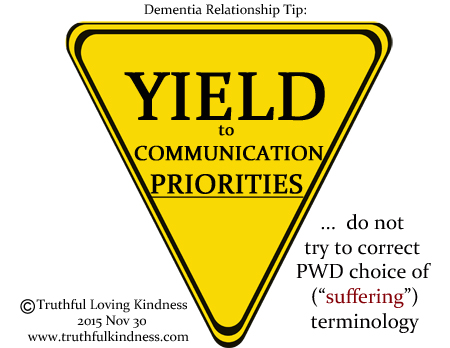
819 blog 20151130y 3in150ppi…  Part 1 of this subject:

https://truthfulkindness.com/2015/12/01/drt-yield-communication-priorities-pwd-suffering-terminology/ (with comments);

Part 2 is at https://truthfulkindness.com/2015/12/03/dementia-suffering-terminology-part-2/ .

Other LINKS on this issue (listed Alphabetically):

PWD George Huba at http://hubaisms.com/2014/02/26/if-you-have-a-rareorphan-disease-and-want-socialpoliticalpharmaceutical-action/ & http://hubaisms.com/2015/12/08/i-refuse-to-suffer-with-dementia/;

PWD Faith Riverstone 1) https://stilllifewithdementia.wordpress.com/2015/12/01/calling-us-sufferers-is-just-wrong-on-so-many-levels/ & 2) https://stilllifewithdementia.wordpress.com/2015/12/03/the-issue-with-calling-us-sufferers-defined/

PWD Harry Urban at https://truthfulkindness.com/index-persons-with-dementia-pwd/harry-urban/advocacy-pt-prspectv-2015-nov-dec/ ;

PWD Kate Swaffer, (DAI etc) http://kateswaffer.com/2014/03/03/empowering-people-with-dementia/http://kateswaffer.com/2014/05/09/i-repeat-please-dont-call-us-sufferers/

Norman McNamara (Purple Angels) at http://tdaa.co.uk/suffering-or-living-with-dementia-you-decide-plz-rt/;

Paul Hitchmough at http://www.onourradar.org/dementia/2015/08/19/people-cant-seem-to-say-what-they-think;

Rick Phelps (Memory People) at http://phelps2645.blogspot.com/2016/01/dementia-patients-suffer-from-sleep.html ;

* Admin issues: SHARE dementia awareness thru buttons below. Feel free to leave your thoughts in the form of comments, but please filter your comments with truthful loving kindness to all concerned. If interested in receiving notice of future blog postings, subscriptions are available through a “follow” button in the upper left corner (MS Explorer) or lower right (Safari, Mozilla Firefox and Chrome). If there is an advertisement below, I have no control over what is shown. My own full legal name is Truthful Loving Kindness. My current diagnosis is Mild Cognitive Impairment. Text for this page took 22 hrs.  Copyright 2016-02/01.  Graphic 2hrs & then was replaced for total 3hrs.

** Began this blog entry December 7, 2015, which was before by friend Barry died (but obviously he was on my mind).

MyFreeCopyright.com Registered & Protected
20-Best Alz Blogs in 2015, 2016, and 2017

alzheimers best blogs badge
Healthline

Importance of Communication with PWD

819 Blog 20160126b commun 3in100ppi

Tru here.  Some people may think I over-emphasize the issue of communication and relationships.
In contrast, personally I think that it is impossible to over-emphasize their importance;
Relationships are what make life worth living,
and communication is the primary building block for relationships.

According to Merriam-Webster “communication”, at its simplest, is “the act or process of using words, sounds, signs, or behaviors to express or exchange information or to express your ideas, thoughts, feelings, etc., to someone else”.  (Personally I might modify that to with “another entity” in order to include non-human communication  —  and then again …  I think information-exchange between different parts of SELF is also a form of “communication” so maybe would prefer Wiki definition instead.)  Wiki says communication “(from Latin commūnicāre, meaning “to share”[1]) is the purposeful activity of information exchange between two or more participants …”

I see verbal and non-verbal communication as the primary building block for relationship,
relationships as building blocks for “community”,
communities (of many different types) as blocks for building a nation, and eventually
… for the world.

Communication is primary pivot-point for all the major topics surrounding the “dementia” issue today (that I can think of):

  • Education: good communication, between the voice of PWD (Person With Dementia) and professionals or others, is essential for public (and especially “professional”) education on topics pertinent to today’s “dementia” issues.
  • Stigma: poor communication creates stigma — and good communication in education will be necessary in order to resolve stigma in positive way.  I believe political coercion rarely resolves stigma in a way that produces lasting positive relationships with the contrasting parties involved.  It may be possible … but I think it rarely occurs and often requires decades to resolve the damage.
  • Financial: poor communication perpetuates lack of funding or “improper” funding — and good communication is necessary in order to resolve funding issues in positive way.
  • Medical: resolving medical issues requires that our medical professions learn to communicate effectively with PWD patient – but all too often (even in early stages like mine) the medical professional has no time or does not have necessary tools to communicate effectively with PWD, so they focus their communication with care-partner.  That is a lose-lose situation because in addition to the patient losing communication and relationship with the medical professional, the professional loses opportunity to learn greater communication skills that can only be consolidated thru experience.
  • The same is true in legal, spiritual, and any other realm I can think of.

As my friend Helga said, “Give us a VOICE – listen to us : we Tell You what Dementia friendly means” – Helga Rohra 2016 Jan 22

(… but that means you must LEARN how to communicate effectively with us.)  In my advocacy efforts I have seen over and over that those who are trying most to help us do not really know how best to communicate effectively with us — or if they KNOW the information they are not able to apply (maybe due to time pressures?).  Over and over again, written (hard copy/digital), audio (my own specialist appointments and “dementia” conferences), and body language — all show either lack of knowledge or lack of time.  PLEASE take the time, show the interest and learn the skills !

“Good” communication requires both out-going and in-coming transmission for the parties involved, … but both transmissions become progressively impaired with all types of dementia at differing rates and categories.  Audio & written, verbal and non-verbal, these impairments create huge problems in communication and require numerous work-arounds by ALL parties who wish to continue communication.  This is a huge subject which I have barely begun to address.

As I have implied above, I think communication is much more than just verbal.  The arts are a major means of communication and that is why I include so many, and such variety of projects here in my blog and newsletter links.  Whether more established types of art like photography, music, woodwork, etc … or simply the creativity of re-purposing materials, or gardening, arts and crafts are a very direct and effective means of COMMUNICATION.

Learning non-verbal communication became especially crucial in training and use of service-animals.  Body language and behavior are always tools for COMMUNICATION between entities, but specialized education is needed in order to receive, understand, and respond to these non-verbal types of communication appropriately, because geography, culture, personal history and individual personality can highly impact this specialized language.

Personally, if there was only one thing I would ask my family to learn, it is the highly specialized non-verbal languages of later-stage dementia.  Learning these NOW would give relief to my concerns for huge misunderstandings and relationship “fall-outs” in my future years.  And for these things Teepa Snow is the best teacher I know of.  So I have financially invested in several of her recorded series, in hopes that my family will, in turn, invest the time and energy needed to learn these language skills.

Sometimes I hear that the PWD is “fading”.  That word always makes me angry because it is important to differentiate between abilities and personhood.  Yes the ABILITIES of PWD (Person With Dementia) are fading – including the abilities for various types of communication.  Because the PWD communication ability is fading, their PERSONHOOD appears to be fading.  This is a totally-unproven theory.  In fact, sometimes in their last days, persons who had seemed to be “vegetable” will almost-supernaturally briefly recover, and verbally communicate.  That could not happen if their personhood was gone!

Be willing to invest NOW in learning communication skills for the later stages, so that you can more easily discern the language spoken in the “fading” communications of late-stage dementia … because relationships are what make life worth living.

Links:

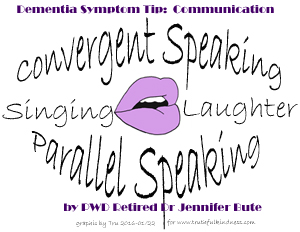
616 JennB 20151222speak 3in100ppi.

Excellent suggestions from PWD retired Dr Jennifer Bute for Helping PWD Speak

at https://truthfulkindness.com/index-persons-with-dementia-pwd/jennifer-bute/helpg-pwd-speak/ ;

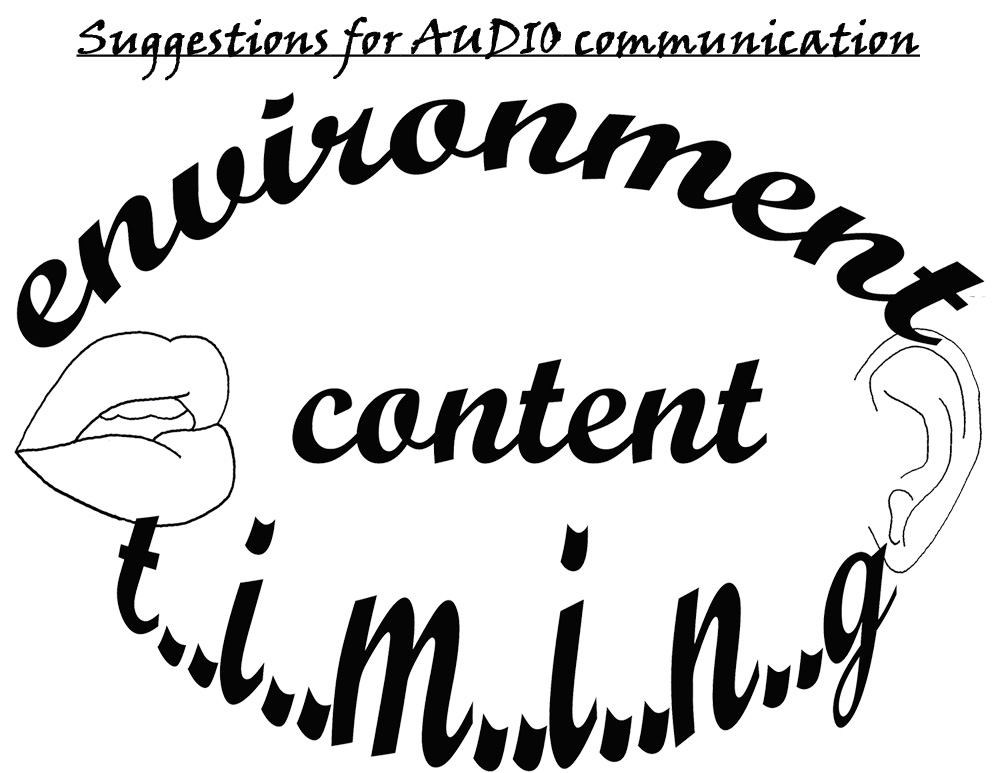
819 Blog commun ECT 5in200ppi.

… AUDIO at https://truthfulkindness.com/2014/12/12/suggestions-understand-audio-communication-dementia-symptoms/ ;

819 Hands Anchor Me 6in.

… NON-verbal at https://truthfulkindness.com/2014/11/07/hold-hand-anchor-me/ ;

.

Richard Taylor PhD had entry “What happened to my Nouns” here >> http://www.richardtaylorphd.com/blog/entry/51-what-happened-to-my-nouns.html but it is not available today.  I will leave the link in case it is a glitch.

819 RobertBowles pic 4in.

… PWD Robert Bowles wrote about example of poor Doctor communication skills

at http://lbdlivingbeyonddiagnosis.com/my-blog/dealing-with-physicians ;

.

Susan Speech Aug2014Lo.

…  PWD Susan Suchan made video on efforts for speech work-arounds

here >> http://www.newson6.com/clip/10916032/fly-the-coop-alzheimers-patient-fights-to-keep-communication-device ;

.

616 HarryU pic4FMN20150928b 5in100ppi… PWD Harry Urban has many entries on relationships / communication

here >> https://truthfulkindness.com/index-persons-with-dementia-pwd/harry-urban/ ;

819 blog 20151222 BackGrnd Noise 3in150ppi

another entry of my own on audio communication

at https://truthfulkindness.com/2015/12/22/drt-background-noise-2015-12/ ;


Merriam-Webster at http://www.merriam-webster.com/dictionary/communication ;

Teepa Snow website RESOURCES at http://teepasnow.com/resources/ ;

Categ: COMMUNICATION at https://truthfulkindness.com/category/important/communication-important/
.
* Admin issues: SHARE dementia awareness thru buttons below. Feel free to leave your thoughts in the form of comments, but please filter your comments with truthful loving kindness to all concerned. If interested in receiving notice of future blog postings, subscriptions are available through a “follow” button in the upper left corner (MS Explorer) or lower right (Safari, Mozilla Firefox and Chrome). If there is an advertisement below, I have no control over what is shown. My own full legal name is Truthful Loving Kindness. My current clinical diagnosis is Mild Cognitive Impairment. Text for this page took 6hrs. Copyright 2016-01/26.

MyFreeCopyright.com Registered & Protected
20-Best Alz Blogs in 2015, 2016, and 2017

alzheimers best blogs badge
Healthline

Recent Pages by others with Dementia Symptoms 2015 January 25

Listed alphabetical by subject: Art, Diagnosis, Relationships, & Stigma

These are newest pages that I have posted from persons with dementia symptoms
who have shared their lived experience thru words or projects.

(I add the word “symptoms” because not everyone uses the same vocabulary;
my collections include pages from those with diagnosis of
Mild Cognitive Impairment as well as Alzheimers, Lewy Body, Vascular and other types of “dementia”)

I thank each of you for your generosity of letting the public into your private world !
My hope is that your perspectives can be applied to help and encourage
other patients, care-partners, and professionals.

Suggest Right-click the TEXT underneath the description, and select “open-in-new-tab”,
which allows you to return to your original page, by clicking tab at top of window.

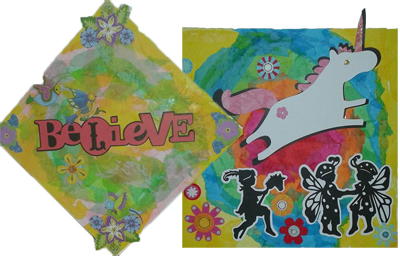
616 Lauren 201601 BelUnicorns 4in100ppi  ART

… by Lauren

… at https://truthfulkindness.com/index-persons-with-dementia-pwd/lauren-u/2016-jan-20/ ;


616 DonnaLynn Morin pic 2012 aftr diagnDIAGNOSIS

… by DonnaLynn

…  at https://truthfulkindness.com/index-persons-with-dementia-pwd/donnalynn-morin/2016-jan-22/ ;


616 HarryU pic4FMN20150928b 5in100ppiRELATIONSHIPS (Tips & Lessons for Care-Partner to Learn)

… by Harry Urban

at https://truthfulkindness.com/index-persons-with-dementia-pwd/harry-urban/relat-2015-nov-dec/ ;


616 JennBute pic 201512009 no permissn yet…  RELATIONSHIPS (Helping PWD Speak)

… by Jennifer Bute

at https://truthfulkindness.com/index-persons-with-dementia-pwd/jennifer-bute/helpg-pwd-speak/


616 CecilRistow PCA Pic3a 2in200ppi…  STIGMA (Prejudice)

… by Cecil Ristow

at https://truthfulkindness.com/index-persons-with-dementia-pwd/cecil-ristow/prejudice-toward-pwd/ ;


* Admin issues: SHARE dementia awareness thru buttons below. Feel free to leave your thoughts in the form of comments, but please filter your comments with truthful loving kindness to all concerned. If interested in receiving notice of future blog postings, subscriptions are available through a “follow” button in the upper left corner (MS Explorer) or lower right (Safari, Mozilla Firefox and Chrome). If there is an advertisement below, I have no control over what is shown. My own full legal name is Truthful Loving Kindness. My current clinical diagnosis is Mild Cognitive Impairment. Each writer retains full copyright for material on linked pages.

MyFreeCopyright.com Registered & Protected
20-Best Alz Blogs in 2015, 2016, and 2017

alzheimers best blogs badge
Healthline

Impact of Terrors and Dreams

819 blog 20160119a 3in100ppi

2026 update: We have now discovered that if Lewy Body type of dementia is present, these are not called nocturnal hallucinations.  Recently found that for ME, these fall under the umbrella term of RBD, aka REM sleep Behavior Disorder.  Some aspects of this disorder have been controlled with medication since shortly after the 1997 onset, but again became more noticeable recently and required an increase in medication.  Made no changes to 2019 blog entry; only adding this preface.

Tru here.  In effort to flush stressful thoughts and re-direct to restful sleep pattern, sometimes I will jot a note in my cell phone (which I keep under my pillow).  Tonight, checking my notes to see if there was anything useful for my blog I found these; some notes from my life in the ultra-vivid alternate-reality of “sleep” (often successive episodic periods of about 1-hour each in a wartime environment).  This type of dream is extremely common among Persons With Dementia symptoms.  During 2012 my night terrors were terrible and prevented almost any sleep that year; I dreaded falling asleep only to spend all my remaining energy (link to example is here >>  https://truthfulkindness.com/2014/09/03/dementia-nightmares-tlk/ ).  When I began Aricept it seemed to keep the terrors to a minimum for several years, but now they are returning to a pretty regular event.  My recent notes:

While falling asleep suddenly REMINDED and confused.  Get ready; I forgot that I am being taken to a holding-cell at the facility.  On the way now. (2015-12/12)

Would it be surprising if I became paranoid, when I spend so many hours being stalked and tortured every night?  My view of reality is probably being altered by these ultra-vivid dreams, even tho I make every effort to keep dream life separated from waking life.  Another effect is that I wake exhausted.  Running, hiding, getting shot and seeing others die is bloody hard WORK ! (1:30am 2015-12/24)

These dreams should produce terror, but instead I experience not really apathy, but imagine it is like being shell-shocked.  Feel over-exposed to blood and guts to the point of extreme sadness (like when observing cannibalism or my pet is skewered as dinner) but no terror remains — just exhaustion.  It feels like I have been working on unbelievably strenuous work all night and I am desperate for some rest.

No; I have very seldom watched violent entertainment at any time in my life.  And now I watch very few shows or movies at all, due to combination of violence and/or complicated plots that I am unable to follow.  When I watch something it is more often a musical or children’s show.

.       *       .       *       .       *       .

Aside from exhaustion, what concerns me more than the night-time violence are the new ultra-vivid dreams that involve people and events that could easily take place in current consensus reality (term from “Deeper into the Soul” book by my friend Nader Robert Shabahangi PhD).  Never experienced anything like this before and these have begun in last few months.

Due to concerns for me to “stay adjusted” to dementia symptoms of hallucinations and night terrors, I have now had a psychiatrist on my medical team for 3 years.  (He says that I have adjusted to past trauma in healthy ways, adjusting to current trauma in healthy ways, and I have no need for any type of psychiatric medication.)  Lately we have been discussing my fear that I will be displaying behavior based on events that have only taken place in my dreams, because it is so difficult to differentiate between these ultra-vivid dreams and daytime life.  … and with my memory problems the events from dreams can have the same emotional effect on my behavior.

I wake, angry from an email or FaceBook posting from someone who sometimes writes things that are not very thoughtful or considerate (and isn’t that ALL of us at some time or another — especially when filters are failing from parts of the brain dying).  Then I realize — Wait a minute; I just read that, but I haven’t had my computer on since last night.  (Seldom look at computer screen during night – even when I cannot sleep I mostly avoid that kind of light.)  So I need to calm down and try to erase those emotions because it did not really happen; it was another dream.  These “reading” dreams happen just as often as the wartime dreams now – but these new dreams involve people I interact with frequently.

What is most disturbing is that I suspect some of my emotions when interacting with these people are probably triggered from effects of things that never really happened — at least not in THIS reality.  I don’t remember why I feel this way about them, but nevertheless those are my feelings!

Similarly to hallucinations, a huge effect of this symptom is the large reminder that I myself am completely unreliable.  What I remember or feel is as unreliable as what I hear, smell, and see.  I must rely on others for REALITY, … and then actually believe and try to integrate their reality over my own perceived reality.

…  Actually, I don’t know if I EVER truly succeed in integrating someone else’s perception of reality as the true occurrences of what is happening !  I try … but I think it is mostly lip-service.  Really I am sure that I am simply seeing a different version of reality – but somehow just as real (and just as important to apply) as my partner’s perceived reality which I am trying so hard to accept.  Just because you didn’t see it doesn’t mean it didn’t happen (in some alternate-reality sort of way).  Because it DID happen … I saw it !

Links:

Example from MY Dementia Nightmares https://truthfulkindness.com/2014/09/03/dementia-nightmares-tlk/

Book “Deeper Into the Soul” $14 +S&H thru publisher; http://www.pacificinstitute.org/eldersacademy.php#deeper with my remarks here >> https://truthfulkindness.com/2014/08/06/bk-deeper/ ;

Interesting notes at https://www.bbc.com/future/article/20210330-why-we-shouldnt-be-afraid-of-nightmares ; “When our brains are in the REM stage of sleep, both the hippocampus and amygdala are highly active. The former is the part of our brain that orders and stores memories, the latter is the part that helps us to process emotions. This has led researchers to suggest that vivid, emotional and memorable dreams during the REM stage are the manifestations of our brains storing memories and “pulling off the emotional tag, or tearing up the receipt”, says Ho. The analogy of taking off an emotional tag is one used widely in sleep psychology.”

Special edition of PWD NewsLetter on this subject Sept 6, 2014 at https://paper.li/f-1408973778?edition_id=9b03d770-363e-11e4-9dcf-0025907212e9
* Admin issues: SHARE dementia awareness thru buttons below. Feel free to leave your thoughts in the form of comments, but please filter your comments with truthful loving kindness to all concerned. If interested in receiving notice of future blog postings, subscriptions are available through a “follow” button in the upper left corner (MS Explorer) or lower right (Safari, Mozilla Firefox and Chrome). If there is an advertisement below, I have no control over what is shown. My own full legal name is Truthful Loving Kindness. My current clinical diagnosis is Mild Cognitive Impairment. Text for this page took 2hrs.  Copyright 2016-01/19.

MyFreeCopyright.com Registered & Protected
20-Best Alz Blogs in 2015, 2016, and 2017

alzheimers best blogs badge
Healthline

Recent Pages by others with Dementia Symptoms 2015 January 12

819 blog 20160112othrs 3in075ppi

Listed alphabetical by subject: Advocacy, Art, Brain function, Craft, Importance of Patient-Perspective, Photography, Prose, Update

I am sorry; thought I posted some of this long ago, but then discovered it was still unfinished in “draft” status, because I apparently made some huge mistakes.  It took me until now to correct mistakes and finish.

These are newest pages that I have posted from persons with dementia symptoms
who have shared their lived experience thru words or projects.

(I add the word “symptoms” because not everyone uses the same vocabulary;
my collections include pages from those with diagnosis of
Mild Cognitive Impairment as well as Alzheimers, Lewy Body, Vascular and other types of “dementia”)

I thank each of you for your generosity of letting the public into your private world !
My hope is that your perspectives can be applied to help and encourage
other patients, care-partners, and professionals.

Suggest Right-click the TEXT underneath the description, and select “open-in-new-tab”,
which allows you to return to your original page, by clicking tab at top of window.


616 HarryU UnitdAgnstD 20150818a

… Advocacy and Importance of Patient-Perspective by Harry Urban 2015 Nov Dec

at https://truthfulkindness.com/index-persons-with-dementia-pwd/harry-urban/advocacy-pt-prspectv-2015-nov-dec/


616 ZelCaddey 20151004marriage 3in100ppi

…  Art by Zel Caddey

at https://truthfulkindness.com/index-persons-with-dementia-pwd/zel-caddey/oct-2015/


616 DavidK pic 20151110a 3in125ppi

Brain function, by Dave Kramer

at https://truthfulkindness.com/index-persons-with-dementia-pwd/david-kramer/2015-nov-10/


616 Gord 20151113 SnoSh Moc 3in100ppi

… Craft by Gord Settle “Snowshoe Moccasins”

at https://truthfulkindness.com/index-persons-with-dementia-pwd/gord-settle/nov-2015-snowshoe-moccasins/


card frm Lauren 201512a 4in125ppi

Craft, by Lauren 2015 December

at https://truthfulkindness.com/index-persons-with-dementia-pwd/lauren-u/dec-2015a/


616 Gord blog 20151231sun 5in100ppi… Photography by Gord Settle

at https://truthfulkindness.com/index-persons-with-dementia-pwd/gord-settle/dec-2015/


616 MaxMcC 20151019b

… Prose by Max McCormick “Tomorrow is a New Day”

at https://truthfulkindness.com/index-persons-with-dementia-pwd/max-mccormick/tomorrow-is-a-new-day-2015-dec-11/


616 KevinSmiley Pic20151216

… Prose by Kevin Smiley “Free My Mind”

at https://truthfulkindness.com/index-persons-with-dementia-pwd/kevin-smiley/dec-2015/

616 DonnaLynn Morin pic 2012 aftr diagn

… Update by DonnaLynn Morin

at https://truthfulkindness.com/index-persons-with-dementia-pwd/donnalynn-morin/dec-2015/ ;


* Admin issues: SHARE dementia awareness thru buttons below. Feel free to leave your thoughts in the form of comments, but please filter your comments with truthful loving kindness to all concerned. If interested in receiving notice of future blog postings, subscriptions are available through a “follow” button in the upper left corner (MS Explorer) or lower right (Safari, Mozilla Firefox and Chrome). If there is an advertisement below, I have no control over what is shown. My own full legal name is Truthful Loving Kindness. My current clinical diagnosis is Mild Cognitive Impairment. Each writer retains full copyright for material on linked pages.

MyFreeCopyright.com Registered & Protected
20-Best Alz Blogs in 2015, 2016, and 2017

alzheimers best blogs badge
Healthline

Unfinished: Complex Role of Task Memory or Husband Gone This Morning

How can this “snapshot” jrnl entry become a tip ?

Decided to start writing in order to track backwards for why I was filling butter dish. Figured it out. This will probably be eventually used as part of a blog entry (on complex use of memory in task completion) in future but this is my morning today.

Needed something and checked dishwasher (which needed emptied).  Can’t remember where some of the dishes belong, so need to put them in dishdrainer by sink.  But there are some dishes in dishdrainer that are now dry (and I know where they belong) so need to put them away before I put wet dishes on top.  First item was butter dish so went to fill it.  Only 2 cubes of butter so checked in freezer.  None in freezer so need to add on grocery list.  Pencil gone so looking for gray mechanical pencil that belongs by grocery list.  Now … why did I need pencil?  Butter.  Wrote butter on grocery list & filled butter dish.  Started writing this.

Took 45min to write this and figure out I was emptying dishwasher (which still needs emptied) but I know there was something I NEEDED from dishwasher.  I remember that it was important but I am shaking badly so maybe I’d better make some protein drink.  THAT was what I started out to do; my mug must be in dishwasher.   … and now it is an hour later and I decide it is more important to stabilize my blood sugar than to empty the dishdrainer or dishwasher.  With protein shaker in hand I discover that my protein mix powder is empty and I need to find my recipe and gather supplies before I can make some.  So I think I had better ask husband to make me something else instead.  Where is my husband?  Car is gone so I look on the new chalkboard at the door.  He went to a doctor appointment.

Unfortunately this type of scenario has become my “new normal” for all day every day (instead of just a few times a day).

Dog is crying so I’d better drop whatever I was doing and take care of that instead.

But I am shaking so badly.

1.5hrs on 20160105 at 9am

journal entry originally posted 2016-Jan-05 (with comments) at https://www.facebook.com/truthful.kindness/posts/10207999241917440

https://truthfulkindness.com/2014/09/09/distorted-decision-making-in-kitchen/

Thoughts on Dementia Symptom Perspectives NewsLetter for 2016

819 blog 20150105 copy

Tru here.

LEGALITIES: Since “Dementia Symptom Perspectives” NewsLetter links are only that – links, no formal approval process is needed. No introduction, copy/paste, or editing is even available for NewsLetter application; only which links are to be included and the order of their inclusion.

CONTENT:

I think almost ANY of these projects (written or otherwise) can be helpful to fellow persons with dementia symptoms, because it shows us different possibilities of projects that we ourselves might be able to enjoy attempting during the progressing stages of dementia, allowing us to document our wishes for the future (and/or begin collecting tools and supplies for various projects). At the same time, those same projects can show OTHERS (family, professionals, etc) that the person is still there. Yes they have changed … but every person changes.

I would like to include as many persons with dementia as possible in the regular NewsLetter, because I think it can be an encouragement to continue attempting projects. In order to have as many participants as possible, NewsLetter must have limit of only one “story” and one “project” from each person with dementia symptoms. Unfortunately the NewsLetter program application cannot “see” links on FaceBook, regardless of whether the setting is public. There are a few other web providers that for some reason this program does not “see”. I try to provide pages in my blogspace for stories and projects from my PWD friends, in order to meet some of that need.

NewsLetter “STORY” may be video, audio, or written, but must be completely composed by the person with dementia symptoms.

NewsLetter “PROJECT” can be written, video, or photo account of project (one project this month is developing their Power of Attorney and another is a book finished and for sale), a compilation from several persons (such as a choral video project), interview with PWD, or arts/crafts/hobby by PWD, etc.

First priority is to those recent entries which are helpful to fellow persons with dementia symptoms: 1) Suggestions for PWD; 2) Better understanding of symptoms and experiences; 3) Simple acknowledgement that we are not ALONE in experiences; 4) Variety of projects available.

Second priority is to recent entries which are helpful to those in association/relationship with those persons, such as family, professionals, etc: 1) Suggestions for person WITHOUT dementia symptoms; 2) Better understanding of symptoms and experiences; 3) See PWD as still “there” – not becoming of lesser value.

If very helpful, up to three additional entries per person can be included in the categorized index page, but only one story and one project per person can go into the regular NewsLetter.

Hope to provide special future NewsLetter issues with Most helpful 2015 links, 2015 Links re Symptoms, and 2015 Links to improve Relationships.  However, my own symptoms have created increasing complications with time requirements.  I am making many more mistakes which must be corrected, and losing track of where I am in projects so constantly that I am now 3 months behind and I realize there is no hope of my catching up to schedule.  I decreased NewsLetter schedule from weekly to monthly in January 2015, and January 2016 I realize I must further decrease schedule from monthly to seasonally in hope to continue the project at all. Very very much appreciate the offer to help in review of blog entries. Your time is valuable to me.

LINK to NewsLetter is https://paper.li/f-1408973778

* Admin issues: SHARE dementia awareness thru buttons below. Feel free to leave your thoughts in the form of comments, but please filter your comments with truthful loving kindness to all concerned. If interested in receiving notice of future blog postings, subscriptions are available through a “follow” button in the upper left corner (MS Explorer) or lower right (Safari, Mozilla Firefox and Chrome). If there is an advertisement below, I have no control over what is shown. My own full legal name is Truthful Loving Kindness. My current clinical diagnosis is Mild Cognitive Impairment. Text for this page took 2.75hrs. Revision of graphic took 1 hrs. Copyright 2016-01/03.

MyFreeCopyright.com Registered & Protected
20-Best Alz Blogs in 2015, 2016, and 2017

alzheimers best blogs badge
Healthline

DRT: No Such Thing as BACKGROUND Noise

819 blog 20151222 BackGrnd Noise 3in150ppi

Tru here.  Single gift that you could give for greatest impact in my current moments with you would be to understand this fact: For me, there is no such thing as BACKGROUND noise.

My brain seems to have lost ability to prioritize audio signals.  It is like my sensitivity sensors are turned up, so even if volume is so low that I am only picking up few of the sounds, it is enough that my attention is distracted, trying to figure out those sounds.  So even tho the sound (of fridge fan, range fan, water running for sink, or the dishwasher) is so low in volume that it is un-noticeable “background” blur to YOUR brain, my brain includes these low-volume sounds in the pile of audio puzzle pieces when trying to follow your conversation.  Then add my constant tinnitus to those sounds.  TV/Radio or multiple conversations at the same table is even more of a problem, even if the volume is very low.  My THEORY on this reasoning is that since all audio signals are now scrambled, the low volume tones are just as crucial as high volume tones, in order to construct puzzle of words being heard.

Since my hearing is considered normal … for an 85 year-old woman (and I am 58years old), I sometimes wear my sophisticated hearing aids.  I usually leave these hearing aids in the “directional” setting, where I will hear sounds from whichever way my head is facing with higher volume than sounds coming from other directions.  With extreme concentration added, the directional hearing aids might make the difference for success in picking out basics of a conversation (from the low murmur of surrounding sounds) for short time periods, but even the directional hearing aids don’t seem to make much difference in my stress level.

Suspect that what I call this lack of audio signal prioritization largely contributes to confusion and over-stimulation in public spaces.  An example might be in medium-sized parking lot this week; my notes say that I was walking in back of parked car, but did not notice motor starting or back up lights.   There was no other motor in the close vicinity, but even with the louder volume right beside me, I did not notice when the vehicle started their engine.  Thus I was quite startled when they began to back up.  Husband said I should hit the back of their car with my walking canes next time ((grin)).

Another example from this week was when grandsons were playing quietly in one corner of room and husband turned on iPad to show daughter a short video (lo volume) in the other side of room …  Everyone was trying to accommodate to my needs by keeping volume low, and I wasn’t angry, but still I needed to leave and find a quiet place for a while.

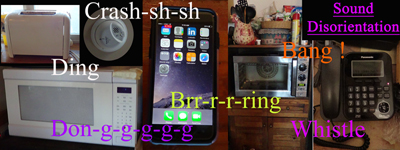
Sound disorientation of different types is a very big problem for me and the majority of my friends with dementia symptoms.  In order to maximize conversations and relationships, it would be really great if confusion from sound sensitivity was better understood by those trying to hold conversations with us.

***


Links:

819 Blog commun ECT 5in200ppi

… I noted this briefly in suggestions

at  >> https://truthfulkindness.com/2014/12/12/suggestions-understand-audio-communication-dementia-symptoms/

Steve Ponath, Harry Urban, & Michael Ellenbogen in Dementia Chats webinar of 2014-07/08 with Steve Orfield (Orfield Labs Minneapolis) about the impact of noise on people living with dementia.  >> https://alzheimersspeaks.wordpress.com/tag/steven-orfield/;

Wendy wrote about it at >>  https://whichmeamitoday.wordpress.com/2015/05/28/noise-v-silence/;

My ear canals are extra-small, so even after special re-construction it hurts to wear hearing aids.  And for ear plugs, I have tried even the “smaller-sized”, but the only ear plugs that are comfortable for me are the bullet-shaped ones found here >>  http://www.amazon.com/gp/product/B00AME3CMM;

819 blog 20150810a 4in100ppi

… Sound Dis-orientation >>  https://truthfulkindness.com/2015/08/11/sound-disorientation-dementia-symptom/


* Admin issues: SHARE dementia awareness thru buttons below. Feel free to leave your thoughts in the form of comments, but please filter your comments with truthful loving kindness to all concerned. If interested in receiving notice of future blog postings, subscriptions are available through a “follow” button in the upper left corner (MS Explorer) or lower right (Safari, Mozilla Firefox and Chrome). If there is an advertisement below, I have no control over what is shown. My own full legal name is Truthful Loving Kindness. My current clinical diagnosis is Mild Cognitive Impairment. Text for this page took 5hrs over span of 4 days. Graphic took 2.5hrs. Copyright 2015-12/22.

MyFreeCopyright.com Registered & Protected

alzheimers best blogs badge
Healthline

My Spiritual Journey in Context of Dementia Symptoms

819 blog 20151214a spiritl 4in50ppi

.

Tru here wishing you happy HAPPY days in December!  Since I hold it as especially private and intimate, I rarely share my spiritual perspective.  So I am hoping that my sharing this spiritual context can enrich YOUR relationship with a loved one who has dementia symptoms.  (And to my own family, this is documentation of my wishes for this matter.)  Please remember that this is MY personal story; your own friend or family member may have no trouble remembering and enjoying new spiritual perspectives.

My thirst for spiritual relationship began very young and was a driving influence for my life.  At my insistence for prayer and such things, our family found a church and began regular attendance there well before I became a “Christian” at five years old.  Now my spiritual perspectives have changed dramatically, but memories of WHY I myself made those changes are growing dim.  Why do I no longer celebrate the special days that my loved ones celebrate?  For past two years I have been forgetting why my spiritual perspective has changed.  Since my husband has never dropped the “Christian” traditions, I suspect that he will get tired of answering my questions for why I decided that we should no longer celebrate with the traditions I remember.  … And actually asking is rather useless since even within minutes of his answer I forget the words and my mind is again asking “WHY”.  Now I remember that I will not understand anyway, so I try to avoid asking.  It is unspoken but very much on my mind.  … And it makes me uneasy.

Since early childhood I very much enjoyed the tradition of tramping thru the woods with the family, Friday after Thanksgiving, searching for the perfect tree, and the sharp scent of fir, spruce, or pine filling the house.  Glass and porcelain ornaments now hang suspended at various places in our home throughout the year, but probably in the next year or two you will again find a decorated tree in our house — because I cannot remember my reasoning in that choice.  i remember my choice, but not why.  In my childhood and during our children’s youth, we spent many happy hours in elaborate decoration of “Easter” eggs.  Soon I suspect you will again find me enjoying those activities, because my theological understanding is going backward in time, as well as all my other memories.  Most events from the last five to ten years are not well-retained at this stage of my life, and I suspect that time period will go further backwards as my symptoms progress.

…   ***   …   ***   …

So far I have not questioned my “Torah-observant” practice of 7th-Day, probably because I do not see it as restrictive but rather as a weekly celebration.  It is simply the tempo of the week — so why NOT celebrate?  ((smile))

But internally I am now questioning my other “Torah-observant” practices.  I know that eventually they will fall away since my family does not hold those same values … and I accept that as okay when it happens.  I do not want to repeatedly wonder why I have restrictions, and don’t want my family to try to convince me to continue a practice that I no longer understand WHY I am doing it.  I call that “ritual without reality”.

What happened?  After many (30) years of daily informal language studies from ancient scriptures, I began Systematic Theology study in 2004, using the well-accepted seminary text of Grudem’s “Systematic Theology”, (supplemented by an extensive set of free audio classes I found, personally taught by Wayne Grudem).  At that point, my un-labeled cognitive symptoms prevented “standard” time expectation for finishing these six courses in various aspects of systematic theology.  It took extra time to finish them, but finish I did.  However, I ended up feeling more uncertain than when I began; my “foundation” of Bible history did not feel as solid as I had expected it would.  So this feeling triggered a larger perspective of study.  2006 to 2008 were spent with intense analysis for textual content in larger perspective of when and where text originated; how, why, by whom, for whom, and in what circumstances it was produced, what influences were at work in its production, and what original oral or written sources may have been used in its composition.  (I discovered this wording for “Biblical Criticism” at theopedia dot com and found it quite accurate to my personal studies.)  My selection of source material began with those acceptable to seminary-level study, but gradually realized these were pre-selecting “acceptable” as according to that seminary’s perception for message of scriptures.  Sources personally “acceptable” as source material began to vary widely and I ended up taking some courses from Yale in the mix along with many others.  I ended up doing a huge amount of reading and accepted few of these “sources” at face value, but in turn questioned the documents these “sources” used as their own source-documents.

I researched and battled out my personal belief statement before I even realized that I was beginning to lose those reasoning abilities.  (But of course I lost the belief statement LOL.)  Since I have spent all this time and energy in research and decision, I strongly object to others confusing me by trying to change my mind with an hour or two of reasoned or emotional arguments now.  I no longer have ability to understand your arguments … or to even understand my own rationale for my decisions.  But I have made my decisions and I remember that they were extremely well thought-out.  Do not try to proselytize me with whatever YOU believe or don’t believe (spiritually and politically); it is of no benefit to either of us, because I no longer have the ability to make those kinds of decisions.

I took lots of notes during those years (none of which I can now understand), and was devastated at my conclusions.  Dropped membership in local “Christian” church, and I cried myself to sleep almost every night for two years at the dis-illusion of my “Christian” Biblical foundation.  Many persons become bitter with these discoveries, but my RELATIONSHIP with Creator remained firm.  However, after those last few years of study my theological stance changed dramatically; on my 50th birthday I changed my legal name to Truthful Loving Kindness in 2007 (based on Hebrew term “chesed v’ emet”), began Torah-observant practices late 2008 (seven years ago) and formally requested conversion in a rather progressive-minded Jewish congregation (2011 Apr 27) while continuing personal study on origin of Hebrew language and scripture.  My conversion request was denied, but my conclusions continued to evolve for the next year or two and I continued worshipping at the Shul from 2008 thru 2014.  Now (2015) I remember meaning for very few of the Hebrew words in the songs or scriptures.  The tunes and rituals are vaguely familiar, but do not have the visceral connection of my own childhood traditions.  I suspect that as my symptoms continue to develop I will especially NEED those childhood hymns to keep myself grounded, so I guess it is a good thing my request was denied because I am again in search of a congregation … while I can still be involved in decision-making process.  Meanwhile I plan to invite a few friends every week to just sing songs; everything from first two verses of “How Great Thou Art” to “What a Beautiful World” … or whatever anyone wants to sing.  We will open our mouths for worship ((smile)).

I remember the vocabulary for what I do believe (and what I disagree with), but no longer remember any of the reasons for agreeing or disagreeing with specific doctrines of organized religion.  … And yet I need to have local persons in like-minded (monotheistic) worship.  Long-distance, internet-based connections do not meet the need for voices raised together in song, or a gentle touch on the shoulder.  My needs are changing.

Since my dementia symptoms continue to advance, it is definitely a time to reach for those common worship traditions which I will probably need in the future.  I pray to find a local congregation soon.  … or maybe we will just continue to sing songs (( smile )).


Tags: Spirituality, symptoms

Other Blogs on related issues:

20130723 zt copy

…  My Faith and My Dementia

at https://truthfulkindness.com/2014/07/16/faith-dementia/


Motiv Ready Set Go

… My Motivating Hopes

at https://truthfulkindness.com/2014/10/31/my-motivation-hope/

819BMPB 2001 Willow Tree only 4in100ppi

… Focus on Essential Priorities

at https://truthfulkindness.com/2015/02/24/dementia-change-priority-pathways/


819 Hands Anchor Me 6in

… Hold My Hand

at https://truthfulkindness.com/2014/11/07/hold-hand-anchor-me/


20161227e-4in100ppi2016 Update at https://truthfulkindness.com/2016/12/27/hol-ctxt-hist-sx/


Alphabetical Links to materials I use most:


Text time:  13.25 hrs in 3days, plus graphic revision 1.5hrs

* Admin issues: SHARE dementia awareness thru buttons below. Feel free to leave your thoughts in the form of comments, but please filter your comments with truthful loving kindness to all concerned. If interested in receiving notice of future blog postings, subscriptions are available through a “follow” button in the upper left corner (MS Explorer) or lower right (Safari, Mozilla Firefox and Chrome). If there is an advertisement below, I have no control over what is shown. My own full legal name is Truthful Loving Kindness. My current clinical diagnosis is Mild Cognitive Impairment. Text for this page took 13 hours in 3 days, and another 1.5 hours trying to revise graphic. Copyright 2015-12/14.  i need to remember that this entry copyright is now impacted by inclusion in book “Dementia-Friendly Worship”, and Jessica Kingsley Publishers now have some influence in usage.

MyFreeCopyright.com Registered & Protected

alzheimers best blogs badge
HealthlineSave

Recent Pages by others with Dementia Symptoms 2015 December 08

819 blog 20151208a 3in125ppi

Listed alphabetical by subject: Coloring, Diagnosis, Hobbies, Painting, Resolutions, Stained Glass, and Technology 

I have been so very busy that it has been over a month since I shared my newest pages.

These are newest pages that I have posted from persons with dementia symptoms
who have shared their lived experience thru words or projects.

(I add the word “symptoms” because not everyone uses the same vocabulary;
my collections include pages from those with diagnosis of
Mild Cognitive Impairment as well as Alzheimers, Lewy Body, Vascular and other types of “dementia”)

I thank each of you for your generosity of letting the public into your private world !
My hope is that your perspectives can be applied to help and encourage
other patients, care-partners, and professionals.

Suggest Right-click the TEXT underneath the description, and select “open-in-new-tab”,
which allows you to return to your original page, by clicking tab at top of window.

616 PaulanG 20151030 mandalas1c 3in150ppi… Coloring project from Paulan Gordon

at https://truthfulkindness.com/index-persons-with-dementia-pwd/paulan-gordon/oct-2015-coloring/;


616 HarryUrban pic 201505

… Diagnosis subject by Harry Urban

at https://truthfulkindness.com/index-persons-with-dementia-pwd/harry-urban/diagnosis-nov-2015/;


616 LaVerneB pic 20110217a

…  Diagnosis subject by LaVerne Belles

at https://truthfulkindness.com/index-persons-with-dementia-pwd/laverne-belles/oct-2013/


616 HarryU lathe 20150831a 2in100ppi

… Hobbies from Harry Urban

at https://truthfulkindness.com/index-persons-with-dementia-pwd/harry-urban/hobbies-nov-2015/;


616 MaxMcC 20151019b

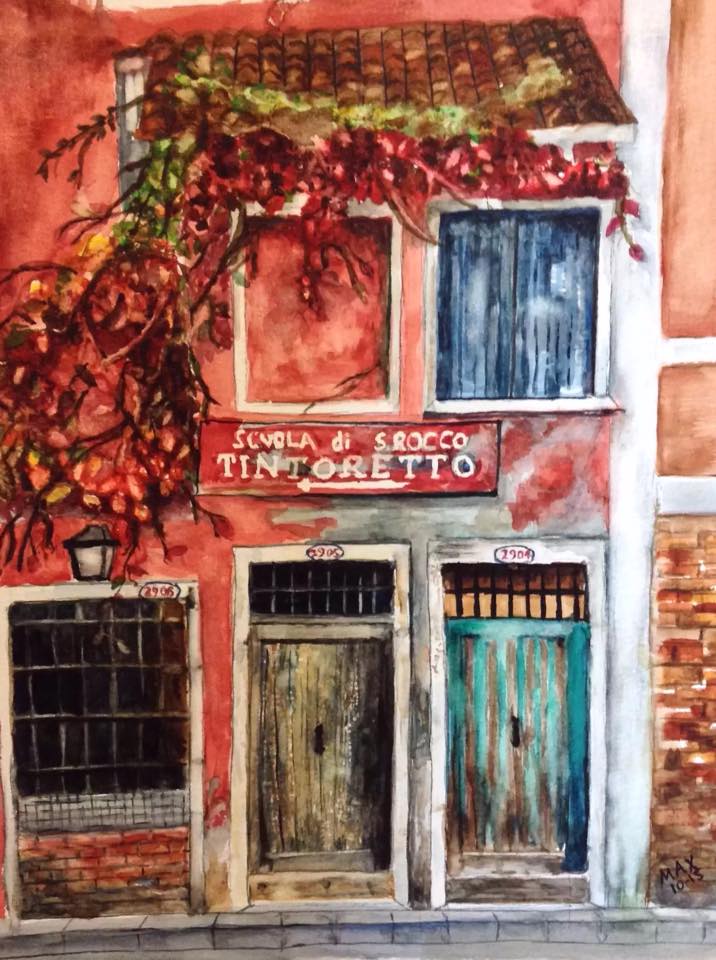
… Painting project from Max McCormick

at https://truthfulkindness.com/index-persons-with-dementia-pwd/max-mccormick/oct-2015/


616 CecilRistow PCA Pic3a 2in200ppi

… Resolutions by Cecil Ristow

at https://truthfulkindness.com/index-persons-with-dementia-pwd/cecil-ristow/nov-2015-resolution/


616 KenH 20151203 Sun3b 4in100ppi

… Stained Glass project from Ken Howard

at https://truthfulkindness.com/index-persons-with-dementia-pwd/ken-howard/dec-2015-stained-glass/


and Technology by Gerald S Publicover at https://truthfulkindness.com/index-persons-with-dementia-pwd/gerald-s-publicover/nov-2015-technology/

* Admin issues: SHARE dementia awareness thru buttons below. Feel free to leave your thoughts in the form of comments, but please filter your comments with truthful loving kindness to all concerned. If interested in receiving notice of future blog postings, subscriptions are available through a “follow” button in the upper left corner (MS Explorer) or lower right (Safari, Mozilla Firefox and Chrome). If there is an advertisement below, I have no control over what is shown. My own full legal name is Truthful Loving Kindness. My current clinical diagnosis is Mild Cognitive Impairment. Each writer retains full copyright for material on linked pages.

MyFreeCopyright.com Registered & Protected

alzheimers best blogs badge
Healthline